

Kelpie Training Tips
Training an Australian Kelpie takes a balance of hard physical exercise, real mental stimulation, and rules that never move. Get those three right and most of the breed’s reputation for being difficult disappears.
Four things do most of the work: combining physical and mental work rather than choosing one, short, varied sessions, high-value rewards inside clear boundaries, and teaching this high-energy dog how to switch off.
Give this breed a job and clear rules, and you get one of the most capable dogs in the country.
The Mistake Almost Every Kelpie Owner Makes
The default fix for a badly behaved Kelpie is more exercise. Longer walks, another run, one more lap of the oval.
It does not work, and it quietly makes things worse. A fit Kelpie becomes a fitter Kelpie, and you end up with a conditioned athlete who still cannot settle at night.
The reason sits in the breed. Australian Kelpies were bred to work sheep across huge distances, all day, making their own decisions. That is a working breed with a genuine work ethic and a natural instinct to move things.
A working kelpie on a station and a suburban kelpie dog have identical wiring. Only the job has changed, and if you do not supply one, the dog will.
The kelpie temperament makes that worse. These are intelligent dogs bred to think independently, so they solve boredom their own way. Fiercely loyal dogs, and among the genuinely smart dogs of the working group, but that intelligence has to be pointed somewhere.
So the honest starting point for most kelpie owners is not more kilometres. It is four things: a job for the brain, a deliberate off switch, a recall that holds, and rules that never move.
Get those right, and the excessive barking, the chewing and the pacing usually sort themselves out.
How Kelpies Learn Best
Balanced reinforcement pairs well-timed rewards with clear, fair boundaries. It is the dog training approach that suits this breed, because Kelpies are quick and willing but need to know where the line sits.
Keep training sessions to five or ten minutes, several times a day. Repetition bores a clever dog, so switch the activity before your Kelpie switches off.
Rotate obedience, tricks, scent work and handling. Training kelpies stays productive when it stays varied.
Teach the basic commands early, and learn to read your dog’s body language so you can step in before they tip over rather than after.
Play is a reward in its own right here, often a better one than food. Roast chicken and cheese still work, but a short game of tug buys you more.
Clicker training suits Kelpies particularly well, because the timing is precise and they read the marker immediately. Add a release word too- the magic word that tells your dog the session has finished.
One thing to avoid. Kelpies shut down or turn reactive under pressure, so shouting produces a flat dog who has stopped offering anything. Kelpies thrive on fair, quiet, and repeatable training.
Give the Brain More Work Than the Legs
Mental Challenges That Actually Tire a Kelpie
Puzzle toys, scatter feeding, scent games, shaping new tricks, and short bursts of training.
Mental challenges tire a Kelpie faster than kilometres do. Ten minutes of scent work beats a second lap of the oval, and you can do it in the lounge room.
Rotate chew toys and puzzles so novelty lasts. A dog who has solved the same feeder forty times is just eating slowly. A rotation of good training toys keeps it fresh.
That balance of physical and mental work is the huge difference between a settled Kelpie and a destructive one.
How Much Exercise Is Enough
As a general rule, one to two hours a day of real activity, and treat that as a floor rather than a ceiling.
Long walks alone will not do it. Ample exercise for a Kelpie means varied work, not distance, because Kelpies love a task far more than a lap.
Agility training is excellent here, and agility courses give a Kelpie something to solve as well as to run. Canicross, swimming and tracking are great fun and genuinely tiring.
This breed suits an active lifestyle. If yours is quiet, be honest about that before you buy one. Our guide on how much exercise your dog needs sets a benchmark.
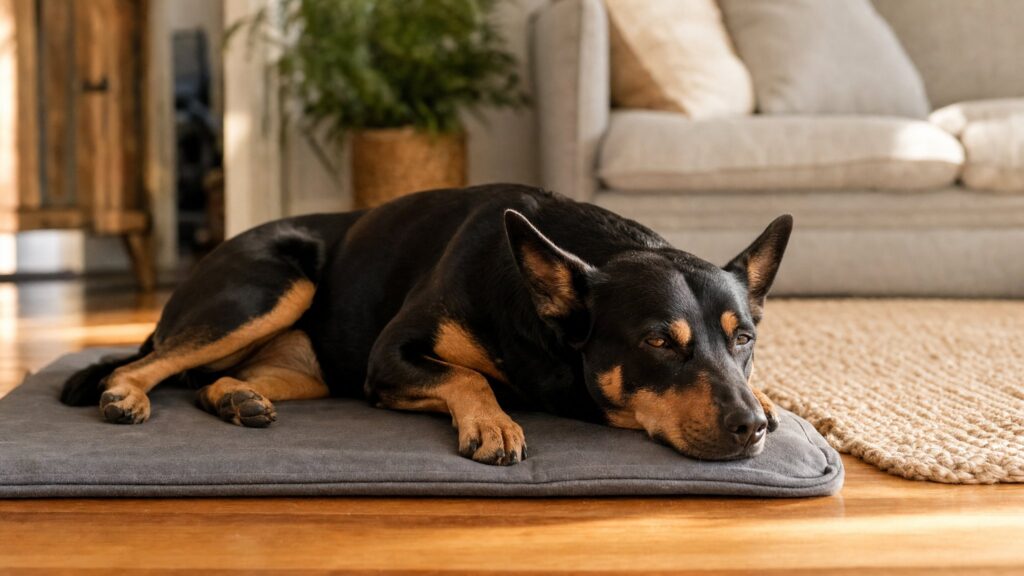
Build the Off Switch Deliberately
Almost everyone trains the going. Very few train the stopping, and that is where the trouble sits.
A Kelpie who cannot relax is not under-exercised. It is a training gap, because calm is a skill you teach the same way you teach a sit.
Use place or mat work and build duration slowly, paying for stillness rather than activity. A crate or pen gives real downtime without the option of patrolling the house.
Schedule rest into the day instead of waiting for the crash. Boundless energy needs an off switch as much as an outlet.
Reward the moments your dog lies down unprompted. That is the behaviour you want more of, and almost nobody pays for it.
Impulse control belongs in the same bucket. Waiting at the door, waiting for the bowl, leave it with food on the floor. All of it teaches a fast dog to pause.
The goal is a super calm dog inside the house who can still switch on the instant you open the back gate.
Make Recall Non-Negotiable
With a dog this fast and this driven, recall is a safety issue rather than a party trick.
Build it on a long lead first, in a quiet space, with a reward worth coming back for.
Never call your dog to something they will not enjoy. Poisoning a recall takes one bad repetition and months to repair.
Practise away from other dogs first, then near them, then through them. Consistent training matters more here than anywhere else.
Channel the Herding Drive Instead of Fighting It
Herding instincts do not switch off in the suburbs. The natural desire to move things becomes chasing cars, bikes, kids, and other animals.
Do not try to delete the drive. Redirect it somewhere legal.
Good outlets include a flirt pole, structured tug with rules, scent games, herding balls, and formal herding if you can access it.
Teach a rock-solid leave it and an emergency stop, because those are the commands that matter at speed. Our guide on how to stop your dog from chasing covers the process.
One caution. Chasing balls endlessly is not the answer, however much your dog begs. Repetitive high-speed fetch builds adrenaline and hammers joints, so keep it finite.
Same principle with digging. Give your dog a designated digging area rather than fighting the instinct across the whole yard.
A Realistic Day With a Kelpie
Owners often ask what this looks like on a Tuesday. Roughly this.
Morning. Forty-five minutes of real work before you leave. Not just a walk. Add ten minutes of training or a scent game so the brain starts tired too.
Middle of the day. A puzzle feeder or frozen chew, then enforced rest in a crate or quiet room. This is the part most people skip, and it is what stops the four o’clock pacing.
Late afternoon. The bigger session. Off-lead work where it is safe, recall practice, structured play with a clear finish, or a class.
Evening. Ten minutes of trick work on the kitchen floor, then mat work while you eat. Calm is trained in the boring hours, not the exciting ones.
The total is not enormous. It is the spread that matters, because a Kelpie with one big burst and nine idle hours fills those hours themselves.
Keep the Rules Identical for Everyone
Same cues, same rules, same response from every person in the house.
Kelpies test rules more than most breeds, purely because they are highly intelligent and notice the gaps. One person letting it slide is all it takes.
Owners are often told they need to be the pack leader. With a Kelpie, what works is calm, consistent guidance the dog can rely on, not dominance. Our post on leadership in balanced training sets out the difference.
Write the house rules down if that is what it takes. Furniture, feeding, doorways, and who is allowed to bend a rule when the dog looks hopeful. Kelpie training holds or falls on that.
If You Are Starting With a Kelpie Puppy
Early training starts at eight weeks. Habits form fast, because a kelpie puppy is always learning something whether you are teaching it or not.
Keep week one small. Name recognition, a sit, settling on a mat, and the beginnings of recall. Training a kelpie begins the day the pup walks in the door.
Socialisation matters here too. Kelpies can be aloof with strangers and other breeds when early exposure was thin, so work through new people, surfaces, sounds, and calm, well-mannered dogs in controlled conditions. Our socialisation guide covers the groundwork.
Watch for the herding attempt at the park. A Kelpie circling and nipping other dogs is not playing, and other owners will not read it kindly.
A young dog given no job picks one, and it is usually the furniture. Our puppy training starts here.
Health and Joint Care Worth Knowing
Kelpies are hardy, athletic dogs, but there are real health concerns. Hip and elbow dysplasia, joint issues such as luxating patella, progressive retinal atrophy, and cerebellar abiotrophy all appear in the breed.
To support joint health in a fast, hard-turning dog, avoid repetitive high-impact work while they are growing, warm up before hard exercise, and keep the dog lean.
Feed a quality dog food that supports joint health, coat condition, and steady energy.
A senior dog needs shorter sessions and lower-impact work, but the mental side still matters to their well-being.
The training relevance is simple. A dog in pain does not learn well, and a sudden behaviour change is a vet question before it is a training one.
When a Trainer Makes the Difference
These are the behavioural issues worth handing to a professional:
- Chasing cars, bikes or livestock
- Nipping or herding children
- Reactivity toward other dogs on lead
- Destruction or barking that is not improving with more exercise
- A dog who genuinely cannot settle, ever
That last one is the most common and the most fixable. If the dog behaviour you are seeing has not shifted after weeks of honest effort, more of the same will not change it.
Our in-home behavioural correction suits this well, because a trainer works through it in your own home, with your dog and your yard.
Ready to Get the Best From Your Kelpie? Contact Allbreeds Today!
Work the brain as hard as the body, keep the rules consistent, and teach the off switch. Basic obedience gives you the vocabulary, but good behaviour comes from the structure around it.
Allbreeds has been training Perth dogs for over twenty-five years, and our Kenwick facility is WA’s largest and most experienced bootcamp. Given the right training, a Kelpie is an ideal pet and one of the best working dogs you will meet.
If your Kelpie has entrenched habits, our K9 Bootcamp works through them intensively with other dogs present. For household-specific problems, in-home behavioural correction is the better fit.
Our free monthly Dog Club then keeps the standard up for the life of your dog.
Reach out to us, and we will put together a plan for your dog.