

The Role of Leadership in Balanced Dog Training
In balanced dog training, leadership means acting as a calm, consistent guide who provides structure, clear communication, and boundaries. It is not about fear or intimidation.
Effective leadership is built on earning a dog’s respect through fair, consistent rules and trust-based guidance.
Good leaders balance affection with authority, ensuring the dog feels safe and understands what is expected. Key aspects include consistency and structure, clear communication, earning respect over fear, managing resources, and adapting to the individual dog’s personality and needs.
When leadership is in place, balanced dog training becomes significantly more effective.
What Does Leadership Actually Mean in Dog Training?
Leadership in dog training is not about dominance, alpha status, or controlling every aspect of a dog’s life.
It means being a reliable, calm, consistent source of guidance that the dog can look to for direction when it is uncertain. From the dog’s perspective, a clear leader reduces uncertainty. The dog knows the rules, understands the expectations, and does not need to make its own decisions in situations it is not equipped to handle.
Effective leadership is built on trust and a respectful relationship, not fear. A dog that obeys out of fear is not a well-led dog. It is an anxious one.
The goal is a cooperative relationship where the dog willingly follows the owner’s guidance because it has learned that doing so leads to good outcomes. This is central to how balanced training works: leadership creates the structure within which rewards and corrections both make sense to the dog.
Why Dogs Need Leadership
Dogs are not naturally independent decision-makers in a human environment. They seek structure and look to their owners for guidance on how to behave.
When clear leadership is absent, dogs fill the void themselves, often with behaviours that owners find problematic: pulling on the leash, charging at the door, excessive barking, or reactivity. This is not defiance.
From the dog’s perspective, it is simply an attempt to navigate an unclear environment without adequate direction.
Inconsistent or absent leadership creates anxiety in dogs, not freedom. Dogs thrive when they understand the rules of their environment and can predict how their owner will respond.
A dog that feels safe and understands its expectations is a calmer, more confident, and more enjoyable companion. This is why leadership is not optional in balanced training. It is the foundation on which everything else is built.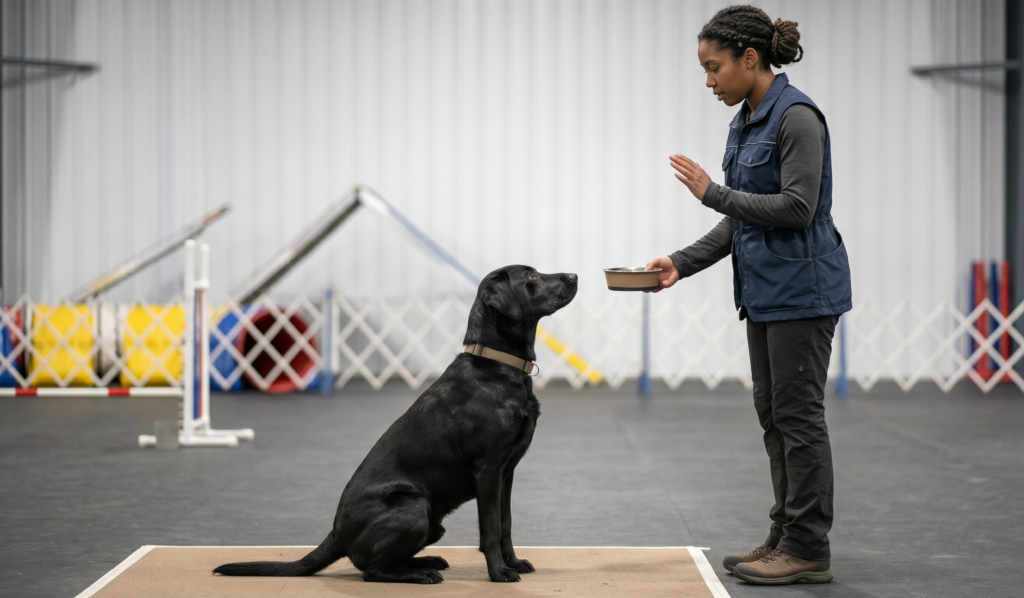
The Key Principles of Effective Leadership
Effective leadership in balanced dog training comes down to a consistent set of principles applied calmly and reliably across every interaction.
Consistency and Clear Boundaries
Clear leadership requires the same rules, the same commands, and the same expectations every time, not just when the owner feels like enforcing them.
If a dog is allowed on the furniture one day and corrected for it the next, it is not the dog that has failed. It is the leadership. Mixed messages create confusion, and confusion creates anxiety.
Consistency must also extend across every person in the household. Mixed signals from different family members make dog training harder and can make problem behaviours significantly worse over time.
Clear boundaries give dogs a reliable framework that reduces anxiety and supports faster learning.
Learn more about how behavioural correction at Allbreeds reinforces consistent boundaries across every interaction.
Calm, Confident Body Language
Dogs are highly attuned to human body language, tone of voice, and emotional state. They read these signals constantly and adjust their own behaviour accordingly.
An anxious, tense, or frustrated handler communicates uncertainty to the dog, which can increase the dog’s own anxiety and reactivity. A calm, grounded presence communicates that the situation is under control and that the owner is a reliable source of direction.
Eye contact, upright posture, and a steady tone all contribute to communicating effective leadership without a word being spoken. A strong leader does not need to raise their voice or escalate. Calmness itself is a signal.
Managing Resources and Building Impulse Control
Controlling access to valued resources (food, space, attention, toys, and play) is one of the most practical ways to establish a leadership role without force.
When a dog has to respond to a cue or wait calmly before receiving what it wants, it develops impulse control and learns to look to its owner for direction. This is not about being withholding. It is about creating a clear communication loop where the dog understands that good behaviour leads to good outcomes.
Rewards and treats become more meaningful when the dog has to earn them. This approach also provides valuable mental stimulation, keeping dogs focused and engaged.
Communicating Clearly Rather Than Forcefully
Effective leadership does not require shock collars, intimidation, or harsh physical correction.
What it does require is clear, well-timed communication: marking correct behaviour promptly with positive reinforcement, providing consistent corrections for non-compliance, and always teaching the behaviour before expecting it.
A dog learns fastest when it understands both what to do and what not to do. Force applied in the absence of teaching creates fear, not understanding. A fearful dog is not a well-led one, and in some cases, fear-based training methods can make aggression and reactivity significantly worse.
How Leadership Supports Behavioural Change
Many of the problem behaviours that bring dog owners to Allbreeds, including aggression, reactivity, anxiety, and destructive behaviour, are rooted in a lack of clear leadership at home.
When a dog does not have a reliable leader to defer to, it manages its own environment, often in ways that are stressful for both the dog and the owner. Especially those dealing with aggression or fear-based reactivity, the absence of strong leadership can make these issues significantly harder to resolve through training alone.
Building effective leadership skills is not just about training the dog. It is about helping owners understand how to communicate, set boundaries, and be consistent in every interaction.
A professional dog trainer helps accelerate this process by identifying exactly where leadership is breaking down and providing practical tools to address it.
When strong leadership is combined with balanced training, the results are faster, more reliable, and far more likely to last, because the dog genuinely understands what is expected and has a leader it trusts.
Interested in Developing Your Leadership Skills? Contact Allbreeds Today!
Effective leadership is not about force, dominance, or constant control. It is about being calm, consistent, and clear in every interaction with your dog. From setting boundaries at the door to building impulse control through resource management, every small moment of clear leadership contributes to a more confident, well-behaved dog.
Allbreeds has been helping dog owners develop strong leadership skills for over 25 years. Whether your dog needs basic structure or is dealing with serious behavioural challenges, our team can help.
Contact us today to find out how our K9 Bootcamp and training programs can support you and your dog.