

How to Stop Your Dog From Chasing
Learning how to stop your dog from chasing comes down to three things: managing their environment, teaching a reliable “leave it” and emergency U-turn, and redirecting their natural prey drive.
Start training from a distance, using high-value treats to reward calm behaviour the moment a trigger appears, so your dog learns to check in with you instead of bolting.
The good news is that chasing is a very natural urge rather than bad behaviour, so the goal is to channel it, not punish it.
With a clear plan, most dogs can learn to stay focused on their owner even when a cat, car or bird flies past.
Why Do Dogs Chase?
Chasing is a natural behaviour for most dog breeds, driven by an instinct that unfolds in a sequence of searching, stalking and chasing. When your dog spots something that moves quickly, that prey drive switches on and the chase feels genuinely rewarding, because it triggers pleasure centres in their brain.
Breed plays a big part in how strong the urge is. Sighthounds like greyhounds and whippets are bred specifically to chase prey, so a sighthound’s natural instinct to pursue a fast cat or a rabbit is hardwired.
Herding breeds often chase bicycles and runners, terriers love chasing squirrels and other small animals, and even mixed breed dogs feel the pull.
Understanding that dogs pursue movement by instinct is the first point to accept, because it shapes how you respond. The catch is that every successful chase makes the habit stronger. If your dog rehearses chasing things over and over, it can become a big problem, so preventing practice is just as important as training.
Manage the Environment First
Before any training sticks, you need to stop the behaviour from happening in the first place. The worst thing you can do is give your dog free rein to chase cars or wildlife while you are still teaching an alternative.
A few management basics that work at home and on a walk:
- Keep your dog on a leash or long line outdoors, and use a fenced area so they cannot bolt.
- Remove the sightlines at home with frosted window film, blinds or curtains, so your dog cannot practise chase behaviours from inside the house.
- Check your property regularly, keeping gates locked and fences tall and sturdy.
- Remember that under Western Australian rules, dogs should be leashed in non-designated areas, and many parks require a lead to protect native wildlife.
Whatever you do, never punish a chase. Punishment can weaken your training and create fear-based reactions, which makes the whole process harder.
Build a Reliable Recall and “Leave It”
A reliable recall and a solid “leave it” are the foundations for stopping a chase, because they give you a way to interrupt your dog before the prey drive takes over. Start in quiet, low-distraction environments where success is easy, then slowly build up to more exciting scenarios.
Long-line practice is your safety net here. Keep your dog on a long line of at least 3 metres, or a 1.8-metre lead, with a well-fitted harness when walking in areas with wildlife, cars or bikes, so you can safely interrupt a chase before they reach the end.
As you train, reward your dog every time they choose to pay attention to you. Watch their body language and step in the moment you see the early signs of fixation, teaching impulse control so your dog learns to pause before reacting.
This kind of good recall is what safely earns your dog time off leash later on, and it is a skill our team refines every day through structured K9 Bootcamp training.
Counter-Condition the Trigger
Counter-conditioning shifts your dog’s attention from the moving object back to you. The moment your dog spots a trigger, whether it is a cat, a car or a bird, mark the calm behaviour with a marker word like “yes” and reward them immediately with an extremely high-value treat.
Over time, your dog learns a new pattern: look at the object, then look back at you for food. Work at a distance where your dog notices the trigger but is not yet reactive, then gradually close the gap as they cope.
Progress is not always linear, so if your dog struggles one day, add more distance and try again rather than pushing on.
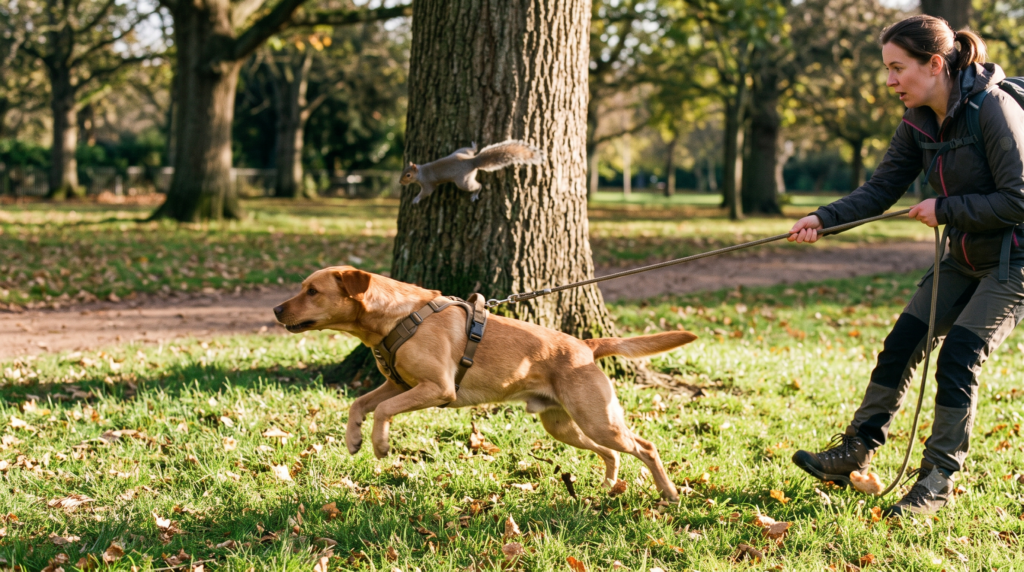
Teach the Emergency U-Turn
Sometimes a trigger appears out of nowhere, and you need an instant exit. This is where an emergency U-turn earns its keep.
Practise a cheerful “this way” cue paired with an abrupt about-face. When you see a distraction such as other dogs or a cyclist, turn and walk briskly in the opposite direction while rewarding your dog for following you.
Done often enough, the turn becomes automatic and gives you a reliable way to stop your dog from committing to a chase.
Redirect the Prey Drive With Better Outlets
Rather than fighting your dog’s natural desire to chase, give it a safe place to go.
A dog with plenty of physical exercise and mental exercise has far less pent-up energy to throw at passing wildlife, and satisfying the natural urge directly is one of the kindest fixes there is.
Great outlets that scratch the chasing itch include:
- A flirt pole, a long wand with a fuzzy lure on the end, which lets your dog chase, catch and tug in a controlled way.
- High-value fetch with a ball launcher, giving the thrill of a chase without any danger.
- Tug-of-war, which mimics the catch-and-dissect part of the hunt and rewards your dog for playing with you instead of chasing off.
- Scentwork and hide-and-seek, which redirect that drive into finding you or a hidden reward.
These games are genuinely fun; they build your bond, and they teach your dog that the best action is with you, not the squirrel across the road.
When Chasing Becomes a Bigger Problem
For most dogs, consistent management and training will steadily reduce the behaviour. But if your dog is fixated, chasing cars or showing intense reactions that are not improving, it is worth getting professional help sooner rather than later.
A head collar can give you extra control on a walk while you train, and an experienced trainer can assess what is driving the chasing behaviour and build a plan around your dog.
If the habit is deeply ingrained, our behavioural correction programs are designed for exactly this.
Ready to Stop the Chase? Contact Allbreeds Today!
Teaching your dog to ignore a trigger and focus on you takes patience, but it genuinely changes daily life for the better. Start small, manage the environment, reward calm behaviour, and give that prey drive a proper outlet.
If chasing has become too much to handle on your own, get in touch with us today, and our trainers will help you build a calm, reliable dog you can enjoy walking anywhere.