

7 Staffy Training Tips
Train your Staffy with short, reward-led sessions of ten to fifteen minutes and firm, consistent boundaries set from the first week. Staffordshire Bull Terriers are smart, strong and heavily motivated by food and praise, so they learn fast when the structure is clear.
Five things do most of the work: reward-based methods, sessions short enough to hold attention, leash manners taught indoors first, real mental stimulation alongside exercise, and early socialisation with people and other dogs.
The catch is strength paired with enthusiasm. A Staffy learns just as fast when you are teaching the wrong thing, and a habit built at twelve weeks is far heavier at twelve months.
1. Start in the First Sixteen Weeks
Start training at eight weeks. Early training beats correction later, and young age matters more with a breed that will eventually outmuscle you.
Week one is deliberately small. Name recognition, a sit, a recall, and settling calmly on a mat.
A staffy requires patience rather than force. They are not slow learners; they are opinionated ones, and proper training works with that rather than against it. Our puppy training starts here.
2. Keep Sessions to Ten or Fifteen Minutes
Short training sessions, repeated across the day, beat one long block. This is where the stubbornness myth comes from. A bored Staffy checks out, and checking out looks like defiance.
End while your dog is still engaged. Pushing on past that point shortens your dog’s ability to concentrate next time.
Use healthy treats in small pieces, backed by praise and a favourite toy, so you are not dependent on food. Good treat selection makes a real difference early on.
Balanced reinforcement is the training approach that suits this breed. Well-timed rewards paired with clear, fair boundaries, so the dog knows what earns a good outcome and what does not.
Staffies respond to that far better than to pressure, and the training methods that work are calm and repeated.
3. Teach Calm as a Command
Most dog owners train the doing and never train the stopping.
Mark and pay calm. The average owner rewards the bouncing, barking version of their own dog without meaning to, simply because that is the version demanding a response.
Teach it deliberately with place or mat work, building duration slowly and paying stillness rather than activity. Reward the moments your dog lies down without being asked.
Impulse control belongs here too. Wait at the door, wait for the bowl, leave it with food on the floor. A Staffy who cannot wait at a threshold is a Staffy who pulls you through it.
Reading your dog’s body language lets you step in before they tip over rather than after.
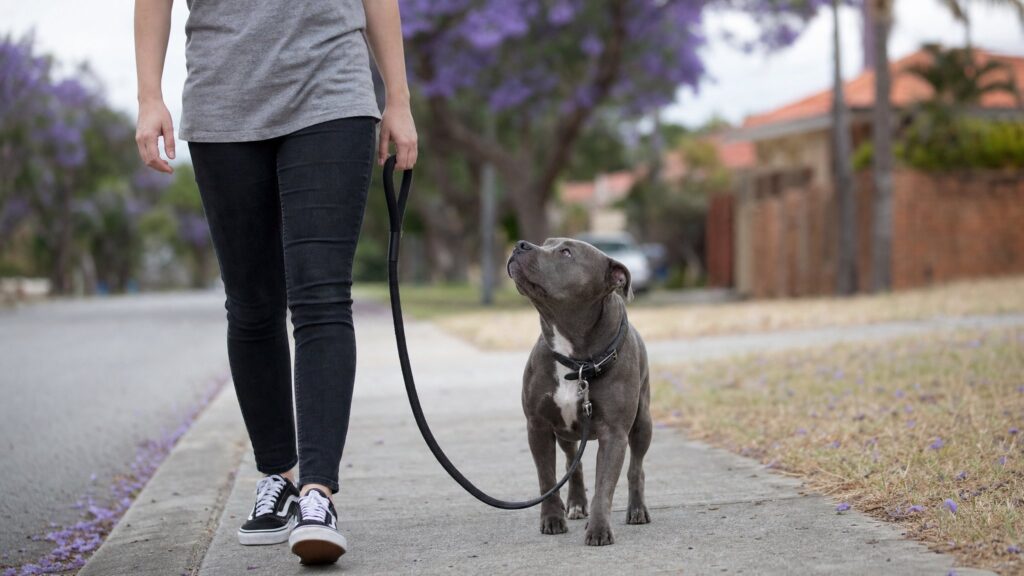
4. Build Lead Manners Indoors First
Practise loose lead walking in the hallway with zero distractions. Then the driveway, then a quiet street, then the real world.
The rule is simple. Stop the moment the lead goes tight, stand still, move forward only when it slackens.
Equipment matters with a dog this strong, and gear fitted correctly makes all the difference. We fit and demonstrate the right kit at handover so you are not guessing at the pet shop.
The target is a dog who will walk calmly past distractions, not one who performs in an empty street. Daily walks are training, not just exercise.
Worth building car rides early too. A strong dog who will not settle in the vehicle quietly limits where you can take them.
5. Socialise on Purpose
Socialisation is the single biggest predictor of how a Staffy handles the world as an adult, and given the breed history, it is not optional.
From eight weeks, work through new people, sounds, surfaces, and vaccinated other animals in a controlled environment.
Quality beats quantity every time. One calm, well-mannered adult dog is worth more than six chaotic ones. Introduced properly means parallel walking first, brief greetings second, off-lead play last.
Reward settled, neutral behaviour around unfamiliar dogs instead of frantic greeting, and take extra care around larger breeds while your dog is still building confidence.
A word on the dog park. It is where a lot of Staffy socialisation quietly goes wrong, because nobody in there is managing anything. Structured meetings with dogs you know beat an open free-for-all, and Staffies thrive on clear situations.
Dog aggression in this breed is usually a socialisation gap rather than a character flaw. Our socialisation guide covers the groundwork.
6. Give That Strength Somewhere to Go
Staffies are smart and highly energetic, so plan on real physical exercise every day plus mental work.
Good physical activity includes brisk daily walks, structured play sessions, and games of fetch and tug. Tug is fine and genuinely useful, provided there is a clear out and a clear finish.
Mental stimulation is the half most owners underdo. Puzzle feeders, scatter feeding, scent games, short training bursts and rotating toys.
Once the basic commands are solid, agility training or scent work gives your dog a job. A working Staffy stays mentally sharp and settles far more easily at home.
There is a mental health angle here as well. A dog left to its own devices finds its own entertainment, and you will not like the choice.
Understimulation is behind most of the chewing and barking we hear about from staffy owners. Our guide on how much exercise your dog needs sets a benchmark.
7. Close the Loopholes at Home
Same cues, same rules, same response from everyone in the house.
The family unit is the training unit. One person letting the rule slide is the loophole your dog is looking for, and Staffies find it fast.
Write the house rules down if that is what it takes. Furniture access, feeding, how visitors are greeted, and who is allowed to break a rule because the dog looked hopeful.
Consistency is what turns a strong, enthusiastic dog into one of the well-behaved dogs at the park. It is also why our handovers spend as much time on the owner as the dog.
The same principles apply to training a Staffy of the American Staffy type. Different breed, same logic.
Why Staffies Are Easier to Train Than People Expect
The personality of a Staffy is willing to the point of being pushy. They are heavily food and praise-motivated; they want to be near you, and they pick up new work quickly. Willingness is rarely the problem.
Strength is. A 10kg puppy who thinks pulling is fine becomes a very different proposition at eighteen months.
The other thing owners underestimate is how sensitive they are. Harsh corrections shut a Staffy down rather than sharpen them up. Shouting produces a flat dog, not a trained one.
Their reputation does not help. The Staffordshire Bull Terrier originated in the Black Country of England, bred from bulldog and terrier crosses.
That breed history left them less naturally tolerant of unfamiliar dogs than most dogs. It also left them extraordinarily attached to people, which is where the nanny dog nickname came from.
Both halves are true. An affectionate breed and famously loyal dogs, and a robust breed that needs deliberate work around other dogs.
It is no accident they are among Australia’s most popular dogs. Their protective nature usually shows up as wanting to be involved in everything rather than as guarding.
One line worth stating plainly: no dog of any breed, however good-natured, should be left unsupervised with young children.
Four Staffy Problems and What Actually Fixes Them
Pulling on the Lead
Why it happens: pulling works; the dog moves forward, so the behaviour pays.
The fix: make it stop paying. Stand still every single time the lead tightens, on every walk, with every handler. Inconsistency here is what keeps most dogs pulling for years.
Jumping on Visitors
Why it happens: jumping earns eye contact, noise, and hands. All three are rewards.
The fix: reward the four paws on the floor version instead, and brief your visitors before they walk in. One guest encouraging the jump undoes everyone else’s work.
Lunging at Other Dogs on Lead
Why it happens: usually frustration rather than aggression. The dog wants to get there, and the lead says no.
The fix: distance first, then reward for looking at the other dog and choosing you. Never correct the growl out of a dog, because the growl is the warning you want to keep.
Where reactivity is established, aggressive dog training is the right starting point.
Chewing and Barking When Left Alone
Why it happens: either boredom or separation anxiety, and the two look identical from the outside.
The fix: work out which one you have. Boredom responds to more mental work before you leave.
Anxiety needs graduated absences built in seconds, no fuss on departure or arrival, and something good to do as you go. Left unaddressed, both produce the same destructive behaviour at doors and furniture. Our guide on being home alone covers the progression.
Health Issues That Look Like Bad Behaviour
Staffies are a generally healthy, hardy breed and typically live twelve to fourteen years. Most unwanted behaviour is training, but not all of it.
Known health issues include hip dysplasia, joint issues such as patellar luxation, skin allergies, and cataracts and other eye conditions. Raise these health considerations with your vet early.
Skin allergies matter more than owners expect, because a dog who is itchy is a dog who is irritable.
That smooth coat needs a weekly brush, which cuts loose hair and lets you check skin health at the same time. Add dental care and basic coat care to the routine.
Feed a dog food built on complete and balanced nutrition. Good balanced nutrition supports skin, joints, and steady energy.
A senior dog needs shorter sessions and softer surfaces. Older dogs still learn; they just need the work adjusted.
The rule of thumb: a sudden change in dog behaviour is a vet question before it is a training one.
When to Call a Trainer
Bring in a professional if you see any of these:
- Reactivity, lunging or growling at other dogs on lead
- Guarding food, toys or resting spots
- Pulling so hard you cannot safely hold the lead
- Distress or damage when left alone that is not improving
- Any bite, or any incident with another dog
Our in-home behavioural correction suits this well, because a trainer works through it in your own home with your actual dog. The right training applied early saves a lot of work later.
Ready to Get the Best From Your Staffy? Contact Allbreeds Today!
Staffies are not hard to train. They are strong, sensitive and quick to learn whatever you happen to be teaching them, which is why the early work matters so much.
Short sessions, clear boundaries, deliberate socialisation and a whole family pulling in the same direction will get you most of the way there.
If you are stuck on pulling, reactivity or a dog who cannot settle when left alone, that is worth sorting now rather than at eighteen months.
Our trainers come to you and work with your actual dog in your own home, where the habits are being formed.
Get in touch with us today and let’s get started.