

How To Train Your Dog To Travel Calmly With Car Anxiety
You train a dog to travel calmly by using desensitisation, building positive associations, and moving in very small steps. Start at the parked car, progress to sitting inside with the engine off, then take very short drives.
Dog car anxiety is usually fear of the movement and the sounds, or a learned link between the car and something unpleasant at the other end. Neither improves by loading your dog in and driving anyway.
Expect days and weeks of short sessions rather than one long one. Rushing is the most common way owners lose the progress they have made.
Most dogs can learn to handle car travel, and the payoff is a dog you can take to the beach, the park and the vet without a fight.
Why Dogs Get Car Anxiety
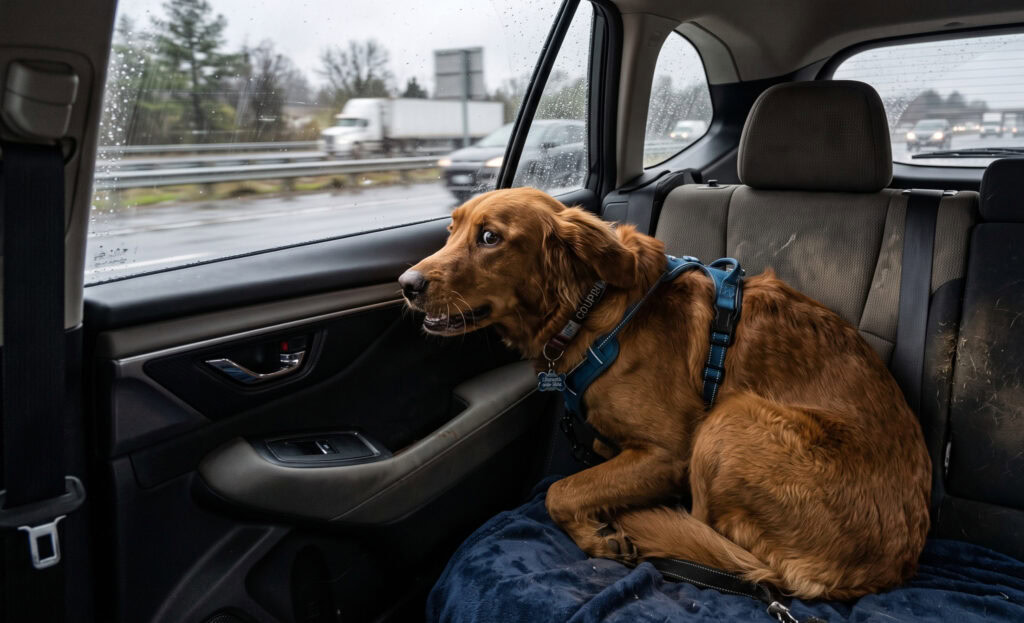
Car anxiety comes from a few places. Some dogs are afraid of the movement itself. Others react to the sounds, from the engine starting to road noise.
Motion sickness makes the whole thing physically unpleasant.
Then there is association. Many dogs only ever go in the car to visit the vet, so they draw the obvious conclusion. Dogs with little car exposure as pups often struggle too.
Watch for these signs:
- Drooling and lip licking, the clearest signs of motion sickness
- Panting, trembling or whining
- Pacing, or refusing to approach the car door
- Freezing, or hiding when the keys come out
If your dog is showing signs before the car has even moved, the fear is about the car rather than the driving.
Reading your dog’s body language early tells you where to start.
1. Set the Car Up First
Sort the practical side before your first session.
Restraint is the safety baseline. A crash-tested seatbelt harness, a secure crate or a cargo barrier keeps your dog safe and stops the sliding that makes anxiety worse.
Put your dog in the back seat or the cargo area. Not the front, not on your lap, and not perched on the centre console where every corner throws them off balance.
Add a favourite blanket that smells like home, and keep the vehicle well ventilated with fresh air or the air conditioning at a comfortable temperature.
Avoid feeding for two to three hours before travel to reduce motion sickness, and give your dog a decent walk first so they arrive tired rather than wired.
2. Desensitisation
The principle is simple. Your dog only moves up a step once they are relaxed at the one before, and every step pays out in food and praise.
Start With the Stationary Car
Walk your dog near the parked car with the engine off. Feed high-value treats, roast chicken for example, and offer praise for calm behaviour, then walk away again before anything tips over.
A few seconds of relaxed sniffing beside the car door is a win. Repeat in short periods across several days.
Sit Inside With the Engine Off
Open the doors and let your dog choose to step in rather than lifting them in. Sit in the car with your dog, feed something genuinely good, then get out while they are still relaxed.
You are teaching your dog to associate the car with good things happening, so end every session as a positive experience rather than waiting for them to run out of patience.
Add the Engine Running
With the car parked, start the engine, reward your dog for staying quiet and settled, then switch it off. Adding the sound on its own stops the engine starting from becoming a trigger in its own right.
Use a release word so your dog knows the session has finished.
Take Very Short Drives
Your first drive is the length of the driveway. The next is around the block. Come home, reward calm behaviour, and stop there.
Short trips repeated often beat one long drive every time. Gradually increase the length over days and weeks, and once you are doing long trips, build in toilet breaks and a stretch every couple of hours before you attempt a proper road trip.
3. Change the Destination
This is the step most owners skip, and it matters more than any product.
If the car only ever goes to the vet or the groomer, your dog has learned that car journeys predict something unpleasant. Avoid taking your dog on vet-only trips.
Mix in the dog park, the beach, a friend’s place, a bush walk. Trips to fun places create positive associations that stick, and predictable routines help dogs feel secure.
4. Calming Aids That Can Help
A few products take the edge off while the training does the real work:
- A pheromone spray in the cabin about 15 minutes before you leave can reduce panting and agitation
- Calming chews usually need around 30 minutes to take effect
- A pressure wrap applies gentle pressure across your dog’s torso, which settles some anxious dogs and does nothing for others
- Soft classical music or purpose-made calming tracks help mask street noise
- A familiar blanket adds one more layer of home
These products help your dog cope. They do not rewire the association on their own. If your dog has severe motion sickness or panics on every trip, talk to your vet about what else might help.
When to Get Professional Help
Get help if your dog’s travel anxiety persists after weeks of gradual work, if your dog panics, soils itself or hurts itself in the car, or if you cannot get near the car door without a fight.
It is also worth help when travel anxiety sits alongside broader anxiety and stress, since the car is often just where it shows up most obviously.
Our in-home behavioural correction suits this well, because a trainer can work through it in your own driveway, with your actual car and your actual dog.
Ready for Calmer Car Rides? Contact Allbreeds Today!
Car anxiety is not something your dog simply grows out of, but it is something most dogs can learn to move past.
The path is steady rather than quick: set the car up safely, work through desensitisation one small step at a time, and change what the car predicts by driving somewhere fun. Go at your dog’s pace, reward calm, and end every session on a good note.
If the fear runs deep, or you cannot get near the car without a fight, that is where a trainer can help. Our in-home behavioural correction works through it in your own driveway, with your actual car and your actual dog.
Reach out to us today, and let us help you get to the beach, the park and the vet without the stress.