

Cavoodle Training Tips
Start training your Cavoodle the day they arrive home, using short, upbeat, reward-based sessions of five to ten minutes. Cavoodles are exceptionally intelligent and eager to please, so early structure matters more than long sessions.
Five things do most of the work: balanced reinforcement, early socialisation between eight and sixteen weeks, daily handling desensitisation, a strict toilet training routine, and crate training that builds independent rest time from the start.
The catch with a clever breed is that it cuts both ways. Your cavoodle puppy picks up bad habits as fast as good ones, and a fortnight learning that jumping earns attention takes months to undo.
Get the early training right, and you end up with a confident, settled adult dog you can take to the beach, the cafe and the vet.
Start Training the Day Your Cavoodle Puppy Comes Home
Early training begins at eight weeks, not after a settling-in week. A new puppy’s first three months shape the adult dog more than anything later.
Keep the first week simple. Name recognition, a sit, recall, and where the toilet is.
Without early structure, a Cavoodle writes its own rules, and those are harder to undo than to build. Our puppy training starts here for exactly that reason.
Use Balanced Reinforcement and High Value Rewards
Balanced reinforcement is the right training approach for this breed. It pairs well-timed rewards with clear, fair boundaries, so your Cavoodle understands what earns a good outcome and what does not.
Rewards do the heavy lifting with a sensitive dog, building trust and strengthening the bond. On their own, they leave gaps, and a clever Cavoodle finds every one.
Harsh methods do the opposite. They create an anxious Cavoodle, and anxious dogs learn slowly.
Keep Training Sessions to Five to Ten Minutes
Short and upbeat, repeated several times a day, beats one long block.
End the session while your cavoodle learns willingly, not after they have checked out. Pushing past that point teaches them that training is something to endure.
Vary what you ask for. Cavoodles disengage from repetition faster than most breeds, so rotate obedience, puppy tricks and handling to keep daily training interesting.
Reward Calm Behaviours, Not Over Excitement
High-value rewards keep motivation up. Roast chicken or cheese will hold a Cavoodle’s attention when dry biscuits will not.
Mark and pay calm behaviours. Most dog owners accidentally reward the loud, bouncing version of their dog, because that is the version demanding a response.
Mix food with praise and a favourite toy so you are not permanently dependent on treats. Good treat selection makes a real difference early on.
Pair Rewards With Clear Boundaries
Reward-led does not mean rule-free. A behaviour-balanced approach pairs every reward with a clear, calm boundary, and Cavoodles need a system without loopholes.
The loophole is almost always a person. One family member letting the rule slide keeps a clever dog testing it for months.
Clarity works here, not force. No shouting, no intimidation, just the same answer every time.
Toilet Training Your Cavoodle Puppy
Take your puppy outside every one to two hours, and straight after they wake, eat, drink or finish playing.
Use the same spot every time. Reward within seconds of the right outcome, not once you are inside.
Build it into your daily routines so the puppy can predict what comes next. Predictability is what makes toilet training click.
Never scold for an indoor accident. Clean it thoroughly, tighten supervision, and move on. Punishment produces a puppy that hides to go rather than one that holds on.
Crate Training and Building Independence
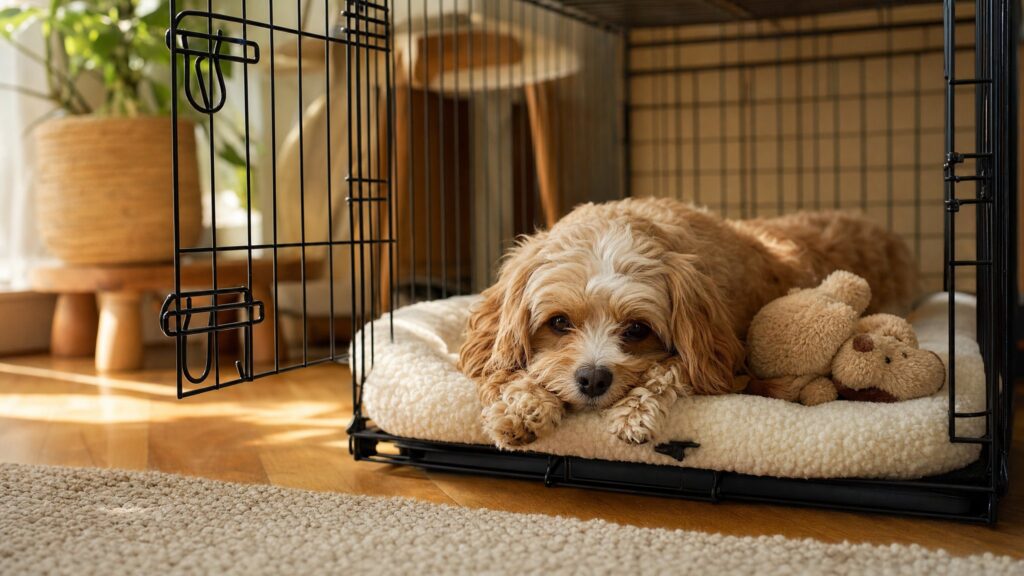
The crate is a safe space, never a punishment. Introduce it gradually, leaving the door open, feeding meals near or inside it, and letting your puppy choose to go in before you close it.
Crate training teaches independent rest time, exactly what a velcro breed needs. Baby gates and pens do a similar job elsewhere.
The measure of success is simple. Your Cavoodle settles without a person in the room and does not treat your absence as an emergency. That is what it means to build independence.
Early Socialisation Between Eight and Sixteen Weeks
The critical window sits between eight and sixteen weeks, and what happens inside it shapes the adult cavoodle you live with.
Focus on safe, controlled exposure. Household noises like the vacuum and washing machine, different surfaces underfoot, new people, and calm, well-mannered other dogs.
Quality beats quantity. One structured introduction to a steady adult dog beats an hour of chaos at the dog park.
Reward settled, neutral behaviour around other dogs rather than frantic greeting.
A well-run puppy school gives structured exposure with a trainer present. Cavoodles thrive on this, and early socialisation is the best defence against anxiety later.
Preventing Separation Anxiety in Cavoodles
Many cavoodles struggle when left alone, and it is the issue that brings most Cavoodle owners to us. The signs are barking, pacing, drooling, refusing food and destructive behaviour at doors and windows.
Start with seconds, not hours. Step out of the room, return before your dog reacts, and repeat until the coming and going means nothing.
Avoid making a fuss when leaving or returning home. Departures and arrivals should be the least interesting moments of the day.
Give your dog something to do as you go. A stuffed chew changes what your leaving predicts.
Do not leave a Cavoodle alone for long periods while you are still building this. Weeks of progress come undone in one bad day.
Emotional regulation is a skill your dog builds slowly, not a switch they already have. Our guide on teaching your dog to be home alone covers the progression.
Handling Desensitisation for Grooming and Vets
Handle paws, ears, mouth and tail gently every day from the moment your puppy arrives. Pair each touch with a reward, so handling predicts something good rather than something to escape.
This matters more for Cavoodles than most dogs. A low-shedding coat means regular grooming for life, and coat types vary from loose wave to tight curl.
Floppy ears also make ear infections common, so ear checks should be a routine part of the week.
Add dental care to the same session. Small breeds are prone to dental problems, and a dog that accepts a toothbrush at twelve weeks accepts one at six.
A Cavoodle that will stay calm on a grooming table saves you money, stress and a sedated groom later.
Loose Lead Walking and Everyday Manners
Loose lead walking starts in your hallway, not on a busy footpath.
The rule is simple. Stop the moment the lead goes tight, stand still, and move forward only when it slackens. Applied every walk, a Cavoodle works this out quickly.
For jumping on visitors, teach an alternative. Reward the four paws on the floor version, and make sure every family member enforces it, because one person encouraging the jump undoes the rest.
Over-train your recall with this breed. Selective hearing is a real Cavoodle feature, and recall keeps a small, fast dog safe.
Sit, drop, place and touch are the puppy tricks that turn a clever pup into a well-behaved adult.
Daily Exercise and Mental Stimulation
Cavoodles need thirty to sixty minutes of daily exercise, split across the day while young.
Physical exercise alone will not settle this breed. Like a Border Collie, a Poodle cross needs its brain worked, so mental stimulation is not optional.
Useful mental enrichment includes puzzle toys, scatter feeding, scent games, short training bursts and rotating toys so novelty lasts.
A dog whose brain has had a workout settles far more easily than one that has only been walked. Understimulation sits behind most of the barking, chewing and digging we hear about from Cavoodle owners.
Consistency Across the Whole Household
The same cues, the same rules, the same response from everyone in the house.
Inconsistency is where attention-seeking habits come from. Your dog is not being difficult; they are testing which version of the rule is real.
Write the house rules down if that is what it takes. Furniture access, feeding, how visitors are greeted, and who gets to break a rule because the dog looked cute.
Both you and everyone else in the home are part of the training picture. Consistency is where cavoodle training succeeds or fails, which is why our handovers spend as much time on the owner as the dog.
When to Get Extra Support
Bring in a professional if you see any of these:
- Distress when left alone that has not improved after weeks of gradual work
- Growling or snapping over food, toys or resting spots
- Reactivity toward other dogs on lead
- Toilet training still failing well past six months
- Behavioural issues getting worse rather than better
Call too if you feel overwhelmed and want a look at the whole picture.
Our in-home behavioural correction suits this well, because a trainer works through it in your own home, with your actual dog and your actual household.
Ready to Get the Best From Your Cavoodle? Contact Allbreeds Today!
Start early, reward generously, keep the rules consistent across the household, and work the brain as hard as the body.
Allbreeds has been training Perth dogs for over 25 years, and our Kenwick facility is WA’s largest and most experienced bootcamp.
If your Cavoodle has entrenched habits, our K9 Bootcamp works through them intensively with other dogs present. If the problems are specific to your home, behavioural correction is the better fit.
Call us, and we will put together a plan that suits your dog.