

4 Rottweiler Training Tips
Rottweiler training should begin early, at 8 to 12 weeks of age. It works best with balanced reinforcement, clear boundaries and consistent practice every day.
A Rottweiler puppy is easy to handle at 10 kilograms. Every habit you allow at that age, you will face again when your dog weighs 50 kg.
1. Start Before They Get Big
Begin basic manners, socialisation and impulse control the day your puppy comes home.
Proper socialisation means calmly exposing your puppy to:
- Different people, including children
- Other dogs that are calm and vaccinated
- New noises, surfaces and safe environments
Well-socialised Rottweilers get along easily with people and dogs. Inadequate socialisation, on the other hand, can lead to anxiety and aggression.
Work on threshold manners early. That means waiting at doors and staying calm around food and toys, which helps prevent resource guarding and reactivity.
Touch your puppy’s paws, ears and face every day as well. A Rottweiler that accepts handling makes vet visits and everyday care far easier at full size.
2. Lead With Calm Confidence, Not Force
Rottweilers thrive on clear communication and trust in their handler. Good leadership means structured guidance and calm confidence, not intimidation.
Forceful training and harsh physical corrections tend to backfire. A Rottweiler is more likely to shut down or resist than to comply.
At Allbreeds, we use a balanced approach. Treats, toys and praise teach the behaviour. Once your dog clearly understands it, a calm, fair correction holds them to it. That builds a relationship based on understanding, not fear.
Keep sessions to about 5 minutes, several times a day. That avoids mental fatigue and selective hearing.
Expect your dog to test the boundaries in adolescence, between roughly 6 and 18 months. It is one of the most common times for problems to appear, and consistency is the key to getting through it.
3. The Four Commands That Matter Most
Leave It
This is one of the most essential safety commands. It can take months of consistent practice to prove reliable, so start early and practise often.
Sit, Down, Stay and Place
Teach these with food lures first, then move to clear verbal cues. “Place” is especially useful for a big dog, because it gives them an off switch when visitors arrive.
Loose Lead Walking
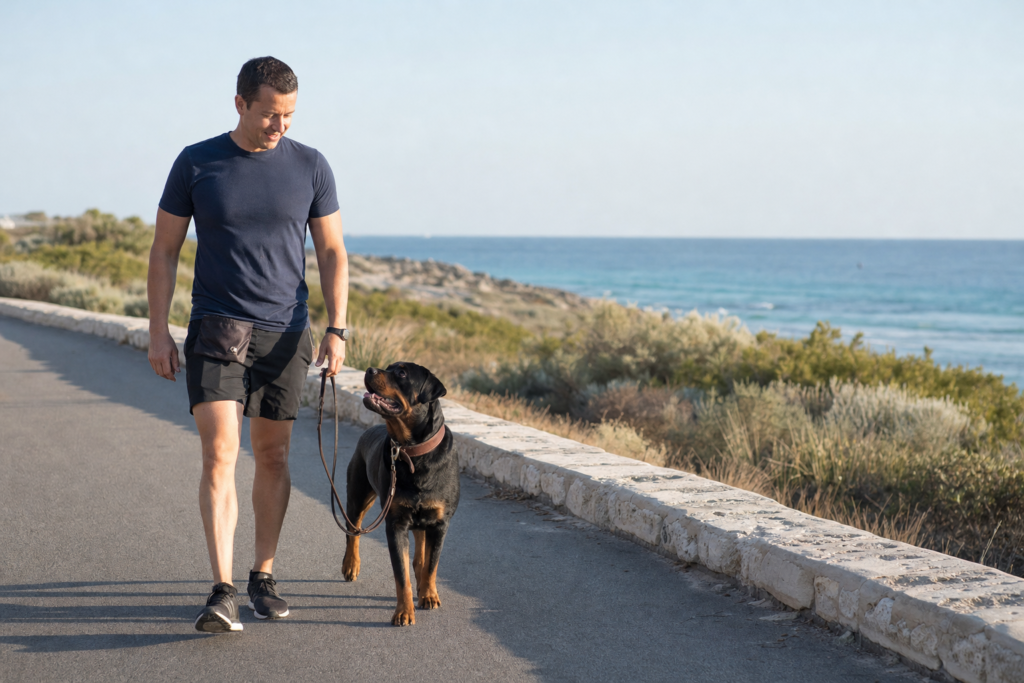
Deal with leash pulling immediately. A 50kg dog that pulls is a safety problem, not just an annoyance.
Teach loose lead walking so your dog learns that walking beside you brings the reward and pulling goes nowhere. Dogs must be on a leash in almost all public areas in Perth anyway.
Recall
Practise recall in low-distraction areas first, such as your home and backyard. Add distance and distractions slowly, only once each step is reliable.
Make coming back the best thing that happens on any walk, and never call your dog to something unpleasant.
4. Exercise, Brain Work and Health
Rottweilers need at least one hour of exercise a day, plus mental stimulation such as scent games, place work and short obedience drills. A bored Rottweiler will find its own use for all that energy.
Puppies need moderate, low-impact exercise while their joints grow. Short walks and free play on soft ground are recommended over long runs or jumping until your vet confirms they have finished growing.
The breed is prone to hip and elbow dysplasia, and gastric torsion is a risk after large meals. Avoid hard exercise straight after eating. Regular vet checks catch health problems early, so discuss a health plan with your vet.
Rottweilers also sleep 13 to 18 hours a day. Rest is part of a healthy routine, not a sign of laziness.
Living With a Rottweiler in Perth
Secure fencing is a must, so your Rottweiler cannot escape.
Under WA law, all dogs over three months must be microchipped and registered with your local council.
Rottweilers are not a restricted breed under the WA Dog Act 1976. However, any large dog can be declared dangerous if it shows aggressive behaviour, which is one more reason good training and supervision matter.
Keep nuisance barking under control too. It keeps the peace with neighbours in suburban living.
Need to Train a Rottweiler? Contact Allbreeds Today!
Training a Rottweiler is far easier with the right guidance, especially while they are still young and easy to handle.
Our team at Allbreeds can help you build calm confidence, solid manners and reliable commands using our balanced approach, so your dog grows into a well-mannered adult you can trust around people and other dogs.
Get in touch with us today, and we will help you start your Rottweiler off on the right paw, from puppyhood all the way to full size.