

Why Your Puppy Bites and How to Stop It
Puppies bite because they are exploring the world with their mouths, working through teething discomfort, and learning how to play. It is a normal part of puppy development rather than a sign of aggression, and almost every new puppy owner deals with it.
The fix comes down to three things: redirection onto chew toys, ending play the moment teeth touch skin, and consistent bite inhibition training.
Puppies start learning this from their mother and littermates, who yelp and walk away when a bite is too hard.
Once your puppy comes home, that job becomes yours.
Why Puppies Bite
Puppy biting is rarely one single thing. Work out which of these is driving it, and the fix becomes much clearer.
Teething and Needle Sharp Teeth
Teething discomfort runs from around three weeks to six months of age. Sore gums make puppies bite and chew for relief, because pressure on something firm genuinely eases the pain.
Those needle-sharp teeth do real damage to human skin without your puppy ever intending harm.
Expect the mouthiness to peak while the adult teeth are coming through, along with a matching spike in chewing around the house.
Exploring the World and Play Biting
Puppies explore using their mouths the way a toddler uses hands. The mouth is their primary sensory tool, so putting things in it is how they gather information.
Play biting is also how puppies play with each other. Your puppy arrives home expecting your hands to follow littermate rules, where teeth are simply part of the game, and nobody complains.
Over-tiredness and Overstimulation
This is the cause most owners miss. An overtired or overstimulated puppy gets frenzied and mouthy, and it reads as naughtiness when it is really exhaustion.
The tell is timing. If the puppy nipping ramps up late in a play session or in the last hour before bed, you are dealing with a tired puppy, not a defiant one.
Seeking Your Attention
Biting gets an instant reaction, every single time. Yelping, pushing your puppy away, laughing, standing up, all of it is engagement.
If teeth reliably produce your attention, your puppy has found a very efficient tool. Most puppies work this out within days of coming home.
How to Stop Puppy Biting, Step by Step
Apply these five steps the same way every time. Consistency, not severity, is what teaches the lesson.
Mark the Bite With a High-Pitched Yelp
The moment teeth touch skin, make one short, high-pitched “ouch”. One sound, then stop.
It mimics a littermate’s yelp and tells your puppy that the contact was too hard. Do not turn it into a stream of noise, because constant talking just becomes background sound your puppy learns to ignore.
Stop Play Immediately
Freeze, stand up, or walk away for 30 to 60 seconds. Play stops the instant teeth land, every time, with no exceptions.
Then resume play calmly. The lesson is cause and effect. Teeth end the fun; a soft mouth keeps it going. Most puppies need this repeated many times across several days before it truly sinks in.
Trade Your Hand for a Chew Toy
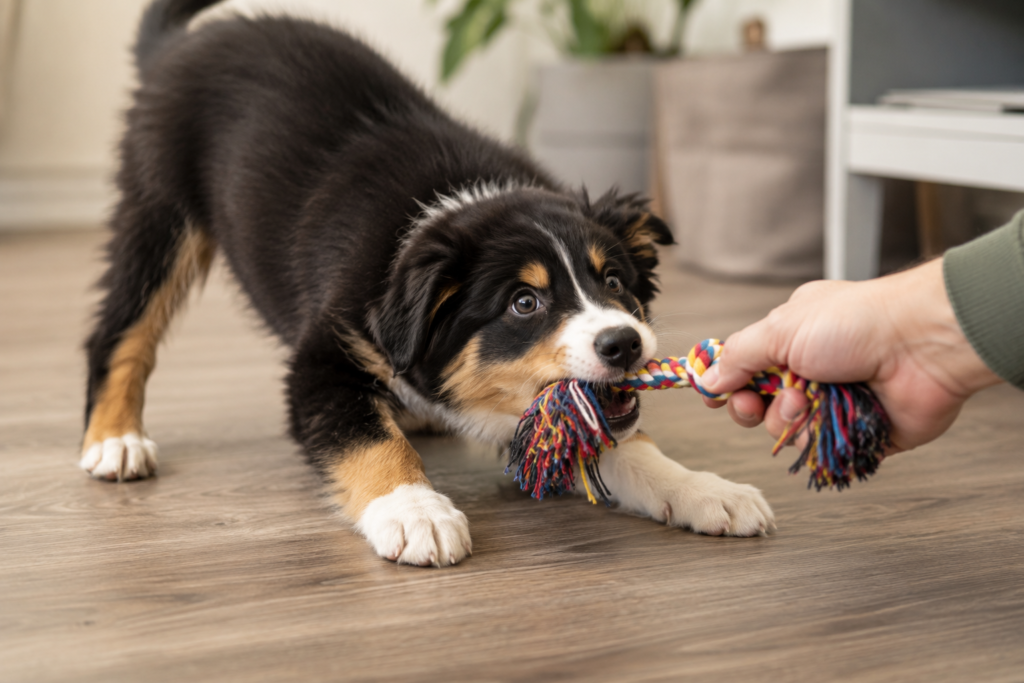
Do not just remove your hand; replace it. Immediately redirect that mouth onto something appropriate so your puppy has somewhere legal to put the teeth.
Keep chew toys and a tug toy within arm’s reach in every room your puppy uses. If the swap takes ten seconds of searching, the moment has already passed.
A rotation of good training toys keeps the trade interesting enough to work.
Reward the Moments They Mouth Gently
Most owners only react to the hard bites, which means their puppy only ever gets feedback for getting it wrong.
Catch the soft moments too. When your puppy takes a treat carefully or plays with a gentle mouth, mark it and reward it. Positive reinforcement for a soft mouth teaches your puppy what you actually want, not only what you do not.
Use a Short Time Out in a Quiet Area
If the biting persists after a few play stops, your puppy is probably past the point of learning anything useful.
Move them to a quiet area, pen or crate for a short settle. Treat it as a reset rather than a punishment. It is never delivered in frustration, and your puppy comes back out once they are calm.
What Not to Do When Your Puppy Bites
A few common habits will quietly undo all of the above:
- Do not wrestle, tease, or use bare hands as toys. Rough play with hands teaches the exact lesson you are trying to unteach.
- Do not snatch your hand away quickly. Fast movement triggers prey drive and makes the game better.
- Do not scold, smack, or hold the muzzle shut. That creates a puppy who is anxious about hands, and anxious dogs bite more, not less.
- Do not let one person in the house play by different rules. One family member allowing hand wrestling undoes everyone else’s work.
Rest, Exercise and Safe Chews
Some of this is management rather than training.
Young puppies need a lot of sleep. Build scheduled quiet rest into the day instead of waiting for the crash, because an overtired puppy is always a mouthy puppy.
Match the outlet to the age. Short walks on leash, brief bursts of activity, and plenty of mental stimulation will burn excess energy without straining growing joints. A puppy whose brain has had a workout settles far more easily than one who has only been physically exercised.
Rotate a few puppy-safe chews so there is always something interesting available, especially through the worst of the teething.
Structured time around other dogs helps as well, since other puppies teach bite inhibition better than any human can. Puppy school and well-run puppy classes are useful for exactly this reason, pairing reward-based training
How Long Puppy Biting Lasts and When to Call a Trainer
Most puppies bite and mouth for roughly six to nine months, easing off as teething finishes and self-control develops.
Consistency is what shortens that timeline. Puppies who get the same lesson from every person in the house improve fastest, while puppies getting mixed messages can drag it out for months.
Not all biting is play, though. Get help if the biting is getting harder rather than softer, if it comes with freezing, growling or guarding, if it seems driven by fear rather than excitement, or if any bite breaks the skin on a child.
At that point, bring in an experienced dog trainer rather than pushing on alone.
Our in-home behavioural correction covers exactly this, and if you are dealing with an adult dog rather than a puppy, start with our guide on how to stop a dog from biting.
Ready to Stop Puppy Biting? Contact Allbreeds Today!
Puppy biting is normal, but it does not sort itself out. A puppy who learns good bite inhibition early becomes a dog you can trust around children, visitors and other dogs.
Allbreeds has been training Perth dogs for over 25 years. Our puppy programs and K9 Bootcamp build bite inhibition, socialisation and impulse control into everyday training with other dogs present, and every client is welcome at our free monthly Dog Club for the life of their dog.
Call us or email [email protected] and we will put together a plan that suits your puppy.