

What Is Crate Training for Puppies?
Crate training for puppies is a training method that uses a crate as a safe, den-like space to support house training, prevent destructive behaviour, and give puppies a calm place to rest when unsupervised.
When introduced correctly, the crate becomes a positive environment rather than confinement, working with a puppy’s natural instinct to keep their sleeping area clean.
By gradually encouraging time spent in the crate using bedding, toys, food, and short training sessions, puppies learn bladder control, settle more easily, and feel secure during busy or stressful moments.
Crate training should always be positive, never used for punishment, and matched to a puppy’s age and needs to avoid anxiety or over-confinement.
What Does Crate Training Mean?
Crate training is a training method that teaches a puppy to view a crate as a safe, comfortable space.
Rather than being about restriction, it helps young puppies feel calm and secure during rest or short periods of unsupervised time, with the crate functioning like a bedroom in the house.
Unlike simple confinement, crate training is a gradual process. Puppies are encouraged to enter voluntarily, rewarded through treats or praise, and only crated for age-appropriate short periods alongside regular play, training, and social interaction.
Crate training aligns with a dog’s natural den instinct. When sized correctly and introduced carefully, a crate becomes a secure retreat that dogs choose to use for sleep and relaxation.
Why Crate Training Works for Puppies
Crate training works because it supports a puppy’s instincts rather than working against them.
When used correctly, crate training helps puppies develop emotional regulation, confidence, and safe habits during a stage when young puppies are still learning bladder control and self-settling skills.
Supports House Training Naturally
Puppies naturally avoid soiling the area where they sleep. Crate training takes advantage of this instinct, making it one of the most effective tools for toilet training puppies and early house training.
When placed in a correctly sized dog crate for short periods, puppies learn to recognise when they need to toilet and hold on until they are taken outside.
Correct sizing is essential. A crate should allow a puppy to stand, turn, and lie down comfortably, but not be so large that they can toilet in one corner and sleep in another.
Oversized crates often slow toilet training and create confusion as a puppy grows.
Creates a Safe and Secure Retreat
A new puppy can quickly become overstimulated by noise, visitors, and daily activity.
A crate provides a predictable, quiet, safe space where puppies can retreat and decompress when they feel tired or overwhelmed.
The enclosed design helps reduce stimulation, allowing puppies to self-regulate and remain calm.
Allowing puppies to enter the crate voluntarily reinforces that it is a safe haven, not isolation.
Respecting the crate as their personal space helps build trust and reduces the risk of separation anxiety.
Prevents Destructive Behaviour
Puppies explore with their mouths, which can lead to chewing furniture, digging, or unsafe exploration when unsupervised. Crate training provides a safe solution when constant supervision is not possible.
With appropriate chew toys, toys, and enrichment, the crate teaches puppies how to settle and rest.
Early exposure to structured downtime reduces destructive habits and supports long-term training success.
Helps with Travel, Vet Visits, and Emergencies
Crate training prepares puppies for situations beyond the home.
During car travel, a dog crate provides a secure and familiar environment that supports safety and calm behaviour.
At the vet, crate-trained puppies settle more easily during examinations or overnight stays, as many clinics use crates for recovery.
In emergency situations, crate-trained dogs adapt more quickly, reducing stress and improving safety for both them and your family.
How to Crate Train a Puppy Step by Step
Successful puppy crate training relies on patience and consistency.
Each stage should progress at the pace of the individual puppy, not a fixed schedule.
Step 1 – Make the Crate Inviting
Place the crate in a social room of the house, such as the living room or a nearby hallway.
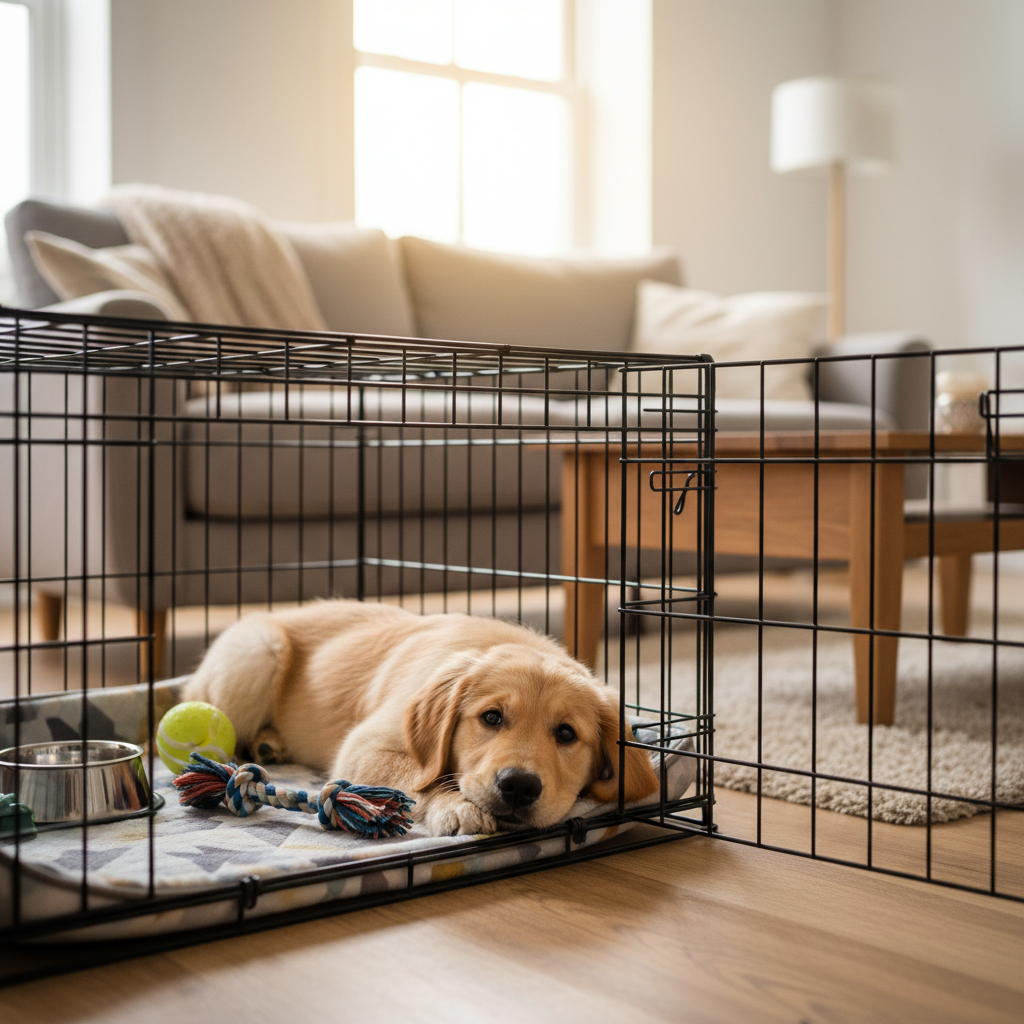
Add a crate mat, a comfortable bed, familiar bedding, and a few safe toys to make the crate inviting.
Keep the crate door open so your puppy can explore freely.
Step 2 – Build Positive Associations
Encourage entry by tossing treats inside the crate, gradually moving them further back as your puppy begins to feel comfortable.
Feeding regular meals near or inside the crate also helps create a positive association.
Never force your puppy inside or close the door prematurely.
Step 3 – Introduce Short Closed-Door Sessions
Once your puppy enters willingly, gently close the door for short periods, starting with seconds rather than minutes.
Watch body language closely. If your puppy appears unsettled, open the crate door calmly. When releasing them, sit quietly and keep interactions neutral to avoid excitement.
Step 4 – Gradually Increase Time and Distance
Gradually build duration by remaining nearby, then stepping into another room briefly. Long-lasting chew toys and enrichment help puppies settle while the door is closed.
Introduce a cue such as “crate” or “bed” as your puppy enters, reinforcing calm entry and training consistency.
Step 5 – Crating During the Day and When Leaving
Begin crate training your puppy during short absences, varying timing so the crate does not always signal departure.
Keep exits and returns calm, and continue to use the crate occasionally while you are home so it remains associated with rest, not absence.
Crate Training a Puppy at Night
At night, crate training supports sleep routines and toilet training. Placing the crate near your preferred location, such as the bedroom or hallway, allows you to hear signals if your puppy needs to toilet.
Quiet whining with restlessness usually signals a toilet need, while persistent crying may indicate discomfort or anxiety.
Keep overnight outings brief and calm, returning your puppy to the crate afterwards.
As bladder control improves, gradually move the crate to its long-term position.
Choosing the Right Crate for Your Puppy
Selecting the right puppy crate plays a major role in successful crate training.
The right crate helps your puppy feel secure and supported as they start training.
What Size Crate Is Best?
A crate should allow your puppy to stand, turn, and lie down comfortably without excess space. Crates that are too large can disrupt toilet training.
Divider panels allow you to adjust space as your puppy grows, making them ideal for long-term use.
Types of Puppy Crates Explained
Wire crates offer visibility and airflow and are often collapsible. Some puppies benefit from partial covers to reduce stimulation.
Plastic crates provide a den-like feel and are commonly used for travel and vet visits.
Soft-sided crates are lightweight but best suited to calm, fully crate-trained adult dogs, not chewing puppies.
How Long Can a Puppy Stay in a Crate?
Crate time depends on the dog’s age and routine. A common guideline is one hour per month of age while resting, though each puppy may need adjustments.
Avoid long periods of confinement.
Crate sessions should follow play, training, feeding, and toilet breaks. When balanced correctly, crate training supports healthy development and emotional well-being.
Learn More about Crate Training at Allbreeds Today!
Crate training can be a powerful tool when it is introduced thoughtfully and used with patience, consistency, and positive reinforcement.
By working with your puppy’s natural instincts, crate training supports house training, emotional regulation, and safe behaviour both at home and on the go.
If you would like personalised guidance or support tailored to your puppy’s age, temperament, and training goals, our team at Allbreeds is here to help you build confident, calm, and well-adjusted dogs from the very beginning.