
How To Stop Resource Guarding and Food Aggression
You stop resource guarding by managing the environment first, then changing how your dog feels about being approached. Counterconditioning and trading up teach your dog that a person walking towards the food bowl means something better is coming, not that something is about to be taken.
One rule matters more than all the rest: never punish a growling dog. A growl is a warning, and punishing it teaches your dog to skip the warning and go straight to the bite.
Resource guarding in dogs is normal behaviour, not dominance or spite. Guarding resources also does not fade on its own, and it gets more dangerous every time your dog rehearses it.
What Resource Guarding Is and Why Dogs Do It
Resource guarding is when a dog uses distance-increasing behaviour, anything from a hard stare to a bite, to keep a person or another dog away from something it values.
When your dog guards things, the list is longer than the food bowl. Food guarding is the version most dog owners notice first, but guarding things like a bed, a crate, a doorway, a favourite chew toy, or stolen food items and food wrappers is just as common. Some dogs guard a person.
The reason dogs resource guard is simple. Dogs learn that valuable things disappear when someone approaches, so they feel threatened and act to keep the resource close. Many dogs arrive with it already in place, from a litter where food was contested or from a shelter.
With a new puppy or new dog, this is far easier to prevent than to unpick. Build the right association from day one, before the unwanted behaviour sets.
Signs of Resource Guarding to Watch For
Resource guarding behaviour almost always announces itself long before it becomes a bite. Your dog’s body language is your early warning system, and reading your dog’s body language is what keeps everyone safe.
Watch for these signs, roughly in order of escalation:
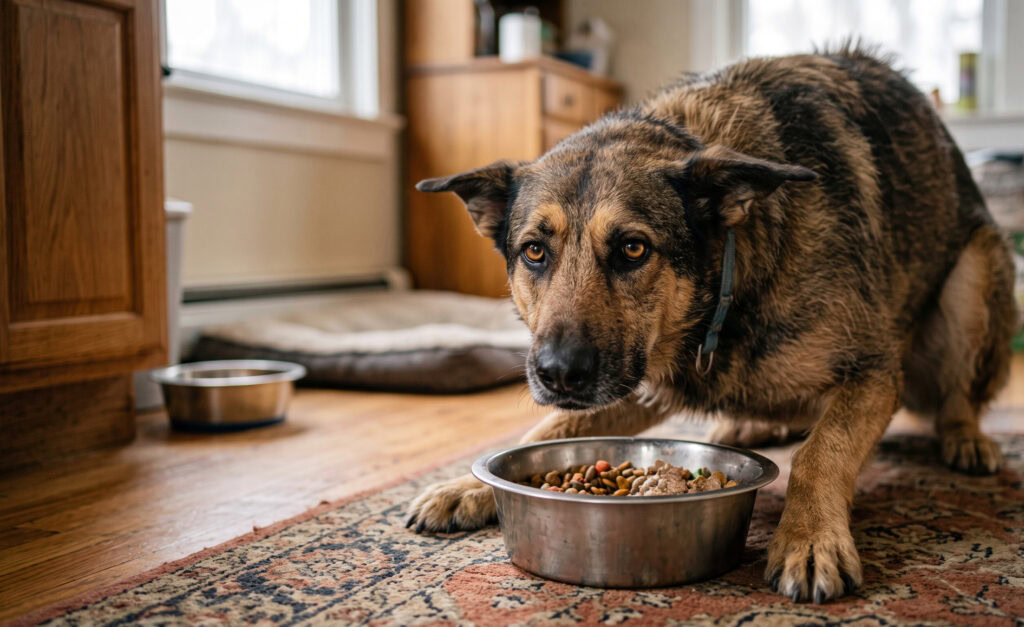
- Your dog begins eating faster, or freezes over the bowl as you walk past
- Hovering over the item, or the dog moves it away from you
- Side eye over a guarded item, where the head stays down, and the eyes track you
- A stiff body, lowered head, ears back and tight lips
- A low growl, then barking, snapping or an air bite
- A bite
The growl is information, not defiance. It tells you where your dog’s threshold sits, which is why it is worth keeping.
Take the other signs seriously early, and you rarely reach the aggressive behaviour at the end of that list.
Rule Out Medical Issues Before Booking an Exam
If guarding appears suddenly in an adult dog, book a physical exam before you start training.
Pain, dental problems and other medical issues can make a pet defensive around food and touch, and no training resolves a behaviour with a physical cause.
Manage the Environment
Management comes first, because it stops your dog rehearsing the behaviour while you do the training.
Feed your dog in a quiet separate area, whether that is a separate room, behind a baby gate, or in a crate, and pick up empty bowls once your dog has finished eating.
Give high-value chews in a safe space where nobody needs to walk past, and never take an item out of your dog’s mouth by force. Trade for it instead.
In a multi-dog household, feed dogs apart rather than in the same room, and supervise chews around other dogs or other animals. Guarding between dogs escalates faster than guarding from humans, and one dog can teach another the habit.
Children and visitors get one simple rule: leave the dog alone while it is eating.
Training That Changes Your Dog’s Emotional Response
Management stops the practice. Training changes how your dog feels, which is the part that actually resolves it.
As with everything we do, the behaviour gets taught first, before anything is asked of the dog.
Toss Treats Into the Bowl as You Walk Past
This is counterconditioning at its simplest. While your dog eats, walk past at a distance they are comfortable with and toss in something better than what is in the bowl. Cooked chicken is a good example.
Then keep walking. You never stop, never reach in, and never take anything away. Close the distance only once your dog stays relaxed, and keep those tasty treats coming every time.
Practise Trading Up
The trade replaces force. When your dog walks off with something they should not have, offer something better, and only pick the item up once they have chosen to let go.
Practise on boring objects, using positive reinforcement every time, so the trade is fluent before you need it on something that matters.
Teach a Solid Leave It and Drop
Build both cues on low-value toys first, and reward with something better than the item your dog gave up.
A reliable recall pairs well with these, because calling your dog away from a stolen item is almost always safer than walking towards it.
Try Hand Feeding to Rebuild Trust
For dogs who guard food at the bowl, hand feeding part of each meal changes the association. Your hands become the source of the food rather than a threat to it.
Only try this with a dog who has never bitten, and stop if your dog stiffens or freezes.
What Not to Do
A few common reactions make guarding worse:
- Do not punish growling. When your dog growls, suppressing it changes nothing about how your dog feels and leaves you with a dog who bites without notice.
- Do not take the bowl away mid-meal to prove a point. It confirms exactly what your dog already suspects.
- Do not put your hands in the bowl or hover over the food while your dog eats.
- Do not chase or corner a dog who has stolen something. Trade, or call them away.
- Avoid raising your voice. Stay calm, because tension around food feeds the problem.
When to Get Professional Help
Get help now if your dog has bitten or snapped at a person, if there are children in the house, if the guarding happens between dogs, or if your dog guards a person rather than an object.
It is also worth help when guarding often sits beside other behaviour issues such as separation anxiety, since the two often share the same underlying worry.
Our in-home behavioural correction is built for this. A one-on-one session means a trainer sees the real set-up and the real triggers, then builds the plan around your dog’s behaviour rather than a template.
Timing matters enormously with any form of dog aggression, and a correction at the wrong moment sets a resource-guarding dog back.
Need Help With a Guarding Dog? Contact Allbreeds Today!
Resource guarding is fixable, but it gets fixed by changing how your dog feels, not by winning the argument over the bowl.
Allbreeds has been training Perth dogs for over 25 years. We handle guarding in the home through behavioural correction, and our K9 Bootcamp builds structure, impulse control and food manners into everyday training with other dogs present.
Call us to get in touch, and we will work out the right approach for your dog!