

7 Labrador Training Tips
The best Labrador training tips come down to seven things. Start the day your puppy comes home, use their food drive carefully, teach impulse control through daily routines, give them at least an hour of exercise a day, and socialise them constantly.
Labradors are easy to train and eager to please. They are also strong dogs with a lot of enthusiasm and very little sense of personal space.
The Labrador is one of the most popular breeds in Australia and, for many households, the best dog for family life. Without structure, though, that friendliness quickly turns into jumping, pulling and bad habits.
1. Start Training the Day Your Puppy Comes Home
Early training starts at around 8 weeks, the day you bring your puppy home. Sit, stay and come are the first three basic commands to teach.
A young Labrador learns fast, and what it learns in those first weeks sticks, good or bad.
Start crate training and toilet training on day one. Short periods in the crate help puppies settle and build the independence that prevents separation anxiety later.
Give your Labrador puppy a structured daily routine, with toilet breaks, meals, training, play, and rest at roughly the same times each day. That predictability makes Labrador puppy training far easier.
2. Use the Food Drive Without Overfeeding
Labs are highly food motivated, so food rewards work well. Use small pieces, and take them out of the daily ration instead of adding them on top.
One of the most common mistakes is treating a Lab like a bottomless bin. Many Labradors carry a gene linked to increased hunger, which makes weight gain easy and hard to reverse.
Keep it simple:
- Feed scheduled meals, with no grazing
- Measure portions
- Use healthy treats such as carrot, green beans and apple
At Allbreeds, rewards teach a behaviour. Once your Lab clearly knows it, you phase the food out, and a calm, fair correction holds them to it.
Most Labs respond well to this. Otherwise, a stubborn Lab learns to wait and see whether the treat is coming before deciding to listen.
3. Keep Sessions Short and Commands Clear
Keep training sessions to 5 to 10 minutes, a few times a day. Labs are easily distracted, and keeping sessions short holds their focus.
Give one clear command, said once. Repeating a command teaches selective hearing.
Everyone in the house needs to use the same words and the same rules. Inconsistent training is the fastest route to poor obedience.
Consistent practice in different places is what gets a Lab listening when distracted, not just in the kitchen.
4. Teach Impulse Control Through Daily Routines
Impulse control is where a Labrador learns to think before it acts, and daily routines give you dozens of free training moments.
Build these in every day:
- Sit and wait before the food bowl goes down
- Sit and wait before doors and gates open
- Four paws on the floor before anyone says hello
- Sit before the ball is thrown when playing fetch
Labs often jump up excitedly when guests arrive. The fix is simple but strict: visitors only greet a dog that is sitting calmly. An overexcited Lab gets nothing until it settles.
Their retrieving instinct helps here too. Fetch played with rules is one of the best self-control games a Lab can learn.
5. Build Walk Manners and a Reliable Recall
Labradors are strong, and leash pulling is one of the most common problems dog owners bring to us.
To teach your Lab to walk nicely, stop the moment the lead goes tight and only move forward once it loosens. Short walks with high standards beat long walks where pulling works.
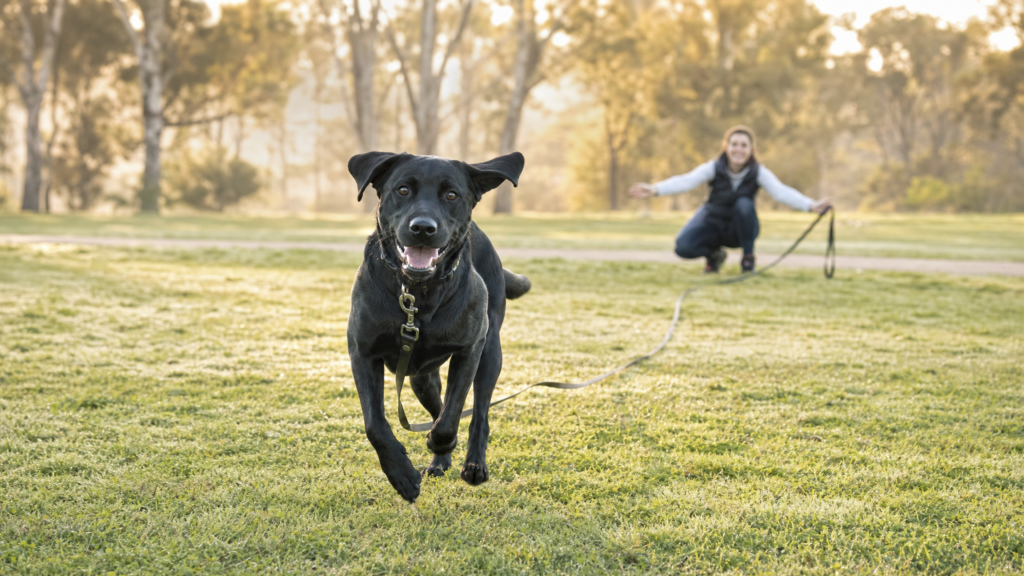
For recall, start in a controlled environment such as the backyard. Then use a long lead in quiet parks before moving to busier areas. Dog parks come last, not first.
A Lab that spots other dogs, a bird or a patch of water will go, so the recall has to be stronger than the distraction.
6. Exercise the Body and the Brain
Labradors need at least one hour of exercise a day, and ideally 60 to 90 minutes of mixed physical activity and mental stimulation. Like most dogs, a bored Lab finds its own entertainment, and destructive chewing is the classic sign.
To prevent boredom, mix physical exercise with:
- Scent work and puzzle toys
- Sturdy chew toys
- Retrieving games
- Swimming
Labs are natural swimmers, but introduce water gradually so they build confidence.
Labradors are also prone to some genetic conditions, including hip and elbow dysplasia. Keep a growing puppy’s exercise gentle, and check with your vet on what suits their age.
Training a Labrador in the Perth Heat
- Train and walk early in the morning or late in the evening over summer.
- Test the pavement with the back of your hand. If you cannot hold it there for a few seconds, it is too hot for paws.
- Swap hot days for indoor brain games.
- Keep your Lab on lead near bushland in snake season.
7. Socialise Early and With Intention
The key window for socialisation is 8 to 16 weeks. Poor socialisation can lead to fear and even aggression. In a friendly breed, it more often produces a Lab with no manners around other dogs.
Introduce new people, sounds and new environments gradually. Choose calm, friendly dogs, meet in a controlled environment and supervise interactions.
Teach children to use gentle handling and to let the puppy come to them. Introduce other pets slowly.
Rescue dogs and older dogs can still learn. Progress may be slower, but the same rules apply.
Need Labrador Puppy Training? Reach Out to Allbreeds!
Labradors are eager to please, which makes them a joy to train and easy to spoil into bad habits.
Get the basics right, and the rest tends to follow: start early, use their food drive wisely, build impulse control into daily life, keep them well exercised, and socialise them constantly.
Stay consistent, keep sessions short, and hold the same rules across the whole household. If jumping, pulling or selective hearing have crept in, that is where we can help.
Reach out to us today, and let us help you raise a calm, well-mannered dog!