

7 French Bulldog Training Tips
Training a French Bulldog requires patience, consistency, and a structured, balanced dog training approach. Frenchies are clever, but their stubborn streak and independent nature mean they will test every boundary you set. They want to do things their own way, and they are remarkably good at holding out until owners give in.
Balanced dog training works particularly well for this breed because it pairs well-timed rewards with clear consequences, giving the dog a complete picture of what is expected. Reward alone leaves too many gaps for a Frenchie to exploit.
As a brachycephalic breed, French Bulldogs also have physical limitations that shape how training sessions run. Short bursts, regular breaks, and awareness of hot weather conditions are non-negotiable with this breed.
French Bulldog Breed Characteristics and Temperament
The French Bulldog temperament is a mix of affectionate loyalty, sharp intelligence, and genuine stubbornness. Frenchies love their people deeply, which makes them highly motivated by attention and touch. They are also toy-motivated and food-motivated, both of which are useful in training.
The challenge is the independent streak. French Bulldogs have a long history of deciding that a command simply does not apply to them today. This is not disobedience from aggression or fear. It is the breed’s natural inclination to weigh up whether compliance is worth the effort.
This is precisely why a balanced dog training approach suits French Bulldogs. The dog needs to understand both what earns a reward and what has a consequence. When only rewards are on offer, a Frenchie will simply opt out when the treat is not interesting enough.
Their flat faces also mean they fatigue faster than other breeds and can struggle in hot weather. Keep this in mind across every training session.
Health considerations for brachycephalic breeds include monitoring for overheating, breathing fatigue, and signs of respiratory distress during and after exercise.
Understanding your French Bulldog’s behaviour in response to heat and physical exertion helps owners adjust training accordingly before problems arise.
1. Start Training Early
French Bulldog training should begin the moment the pup comes home. Not after a settling-in week.
Bad habits form fast with this breed, and they harden even faster. A Frenchie that spends its first two weeks learning that jumping gets attention, that ignoring its name has no consequence, and that the lounge is fair game will carry those habits for a long time.
Early training means establishing good habits before bad ones have a chance to take root. Puppy training that starts early also means the dog builds a positive relationship with structure from the outset, rather than learning to resist it later.
Start with name recognition, a sit, and a basic recall. Keep it simple, keep it consistent, and do not skip days.
Consistent puppy training from the moment the dog enters the home is the single most effective thing you can do for its long-term behaviour.
While an adult French Bulldog can still be trained effectively, breaking established habits takes considerably more time and effort than building good ones from the start.
2. Keeping Training Sessions Short and Manageable
French Bulldogs get bored quickly. As a brachycephalic breed, they also tire faster than most dogs. Training sessions should be kept to 1 to 2 minutes at a time, repeated in short bursts throughout the day rather than in one long block.
End each session before the dog’s ability to concentrate runs out, not after. A Frenchie that has mentally checked out is not learning anything useful, and pushing past that point creates frustration on both sides.
Within a balanced dog training framework, short sessions still include both clear rewards for correct responses and a calm correction when the dog ignores a command. Do not let things slide just because the session is brief. Consistency is what gradually increases the dog’s ability to focus and respond reliably.
Use high-value treats or a favourite toy to keep motivation up, and vary what you offer so the dog stays engaged across sessions.
3. House Training and Potty Training Your French Bulldog
Potty or toilet training is one of the most common struggles for French Bulldog owners. The breed is not impossible to house train, but it requires a strict routine and absolute consistency across all family members.
Establish a schedule from day one. Take your French Bulldog puppy to the designated toilet spot every one to two hours during the day. Always go to the same spot. Reward immediately when the dog goes to the right place. Timing matters here: the reward needs to come within seconds of the correct behaviour, not when you are back inside.
Never scold or punish for indoor accidents. Stay calm, clean it up thoroughly, and tighten your supervision. Punishment creates confusion and anxiety, neither of which helps a Frenchie learn.
The balanced dog training approach here is straightforward: reward the right outcome and manage the environment so the wrong outcome becomes less likely.
Everyone in the household must be on the same page. One person leaving the routine creates setbacks for everyone.
4. Building Name Recognition and Attention
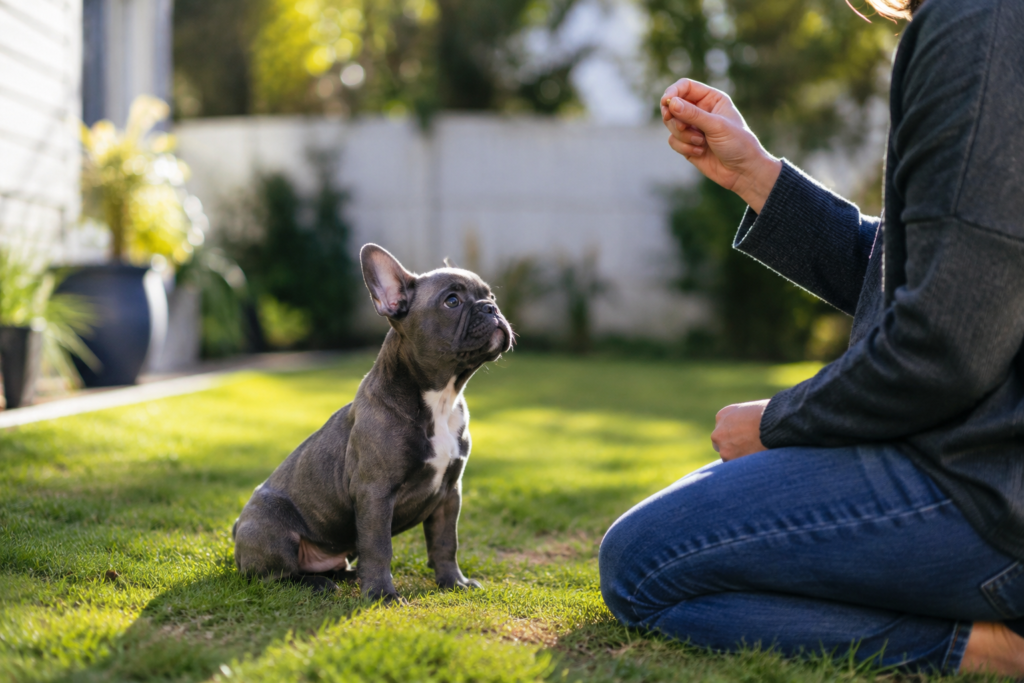
Before any other training can stick, your Frenchie needs to understand that their name means one thing: stop what you are doing and look at me.
Say the name once. Wait for eye contact. Reward the response immediately. Do not repeat the name over and over if the dog ignores it. Repeating a command teaches the dog that the first time does not count.
Within a balanced dog training approach, if the dog ignores its name consistently, a gentle interrupter, like a sound or a light leash touch, breaks their focus so you can reset and get the response. Always reward when the dog turns to you.
This is the foundation for every other command. A dog that does not respond to its name reliably cannot be expected to follow more advanced training instructions.
5. Teaching Leash Manners and Walking Behaviour
French Bulldogs are surprisingly strong for their size and prone to pulling on the leash. Left unaddressed, pulling quickly becomes the default, and with a brachycephalic breed, hard pulling also strains the airway.
The correction is straightforward: stop walking the moment the leash goes tight. Stand still and wait. Move forward only when the leash slackens. This teaches the dog that pulling stops forward movement. Consistency across every single walk is what makes it work.
Within balanced dog training, leash pressure is a tool the dog learns to read. Pressure means stop or turn. A loose leash means keep going. The dog figures this out quickly when the rule is applied every time, not just sometimes.
Also teach a strong emergency recall word using high-value treats for off-lead safety. Frenchies can slip leads, and a reliable recall can prevent serious incidents.
6. The Role of Crate Training
Crate training is one of the most effective tools available for French Bulldog owners. It gives the dog a calm, safe space to settle, supports the house training routine, and builds independence from an early age.
Introduce the crate gradually. Place it in a quiet area, leave the door open, and let the dog explore it on their own terms before building up duration. Feed meals near or inside the crate to build a good association.
In a balanced training context, the crate is a management tool, not a punishment. It creates structure when you cannot actively supervise the dog, which is exactly when French Bulldogs are most likely to practise bad habits.
Frenchies that sleep in the crate overnight also tend to settle more easily and show less separation anxiety over time.
7. Socialise Your French Bulldog
Early socialisation is essential for French Bulldogs. Without structured exposure to other dogs, other pets, and new environments, Frenchies can develop behaviour problems including reactivity, fear, and overexcited greetings that are hard to walk back later.
Socialisation through a balanced dog training lens means controlled, calm exposure with clear leadership from you. It does not mean letting the dog rush up to every dog it encounters.
- Arrange playdates with calm, well-behaved adult dogs rather than chaotic dog park visits.
- Expose Frenchie puppies to different surfaces, sounds, and environments from an early age.
- Reward calm, neutral behaviour around other dogs. Do not reward frantic excitement.
The goal is a dog that notices the world and remains settled, not one that feels entitled to interact with everything it sees.
Need A Professional French Bulldog Trainer? Contact Allbreeds Today!
If training French Bulldogs has stalled, behaviour problems are escalating, or you are not sure where to start, professional support from an experienced dog trainer familiar with the breed makes all the difference.
AllBreeds uses a balanced dog training model that suits French Bulldogs well. The programmes account for the Frenchie’s stubborn streak, independent nature, and physical limitations, delivering structured, breed-specific results.
Training classes, group programmes, and residential options are all available depending on where your dog is.
Learn more about French Bulldog training in Perth or book a program with the Allbreeds team.