

6 Golden Retriever Training Tips
Training a golden retriever requires strict consistency, clear structure, and constructive outlets for their naturally mouthy and high-energy instincts. Because goldens are highly sensitive, eager to please, and slow to mature emotionally, they need a balanced dog training approach that rewards the right behaviour and sets firm boundaries when they push back.
They are one of the most trainable dog breeds in the world. But without structure, their enthusiasm for people, tendency to mouth and carry everything, and seemingly endless energy can make daily life genuinely difficult for golden retriever owners.
The key areas to get right from the start: impulse control, managing the mouthy phase, keeping training sessions short and structured, providing adequate mental and physical exercise, and socialising with intention.
Understanding Golden Retriever Temperament
The golden retriever temperament is friendly, intelligent, and deeply people-oriented. Goldens love everyone, which is part of their appeal, but it also creates real training challenges.
Their eagerness to please makes them fast learners. Their slow emotional maturity means many golden retriever owners are still dealing with puppy-like behaviour well into the first two years of the dog’s life.
Not all dogs of the same breed are identical, but as a general rule, goldens respond best to a balanced dog training approach that rewards good behaviour and sets clear limits when they push boundaries.
1. Start Training at an Early Age
Golden retriever puppy training should begin the moment the pup comes home. At this early age, a golden retriever learns new habits fast and responds well to structure.
Waiting until problems appear makes training harder. Every week without structure is a week the puppy practises behaviours you will later need to undo.
Puppy training sets the foundation for everything that follows. Basic commands like sit, stay, come, and heel should be introduced early, before distractions and competing drives make them harder to teach.
Introducing crate training early is also worth doing. It gives your puppy a calm, safe space to settle and prevents destructive habits from forming when you cannot supervise.
2. Build Impulse Control First
One of the most important golden retriever training tips is to prioritise impulse control before anything else.
Goldens love everyone and everything, which often shows up as jumping on people, frantic greetings, and pulling on the leash. These are not personality quirks to tolerate. They are habits that need to be addressed with clear, consistent boundaries.
Practical steps for building impulse control:
- Ignore jumping. No eye contact, no touch, no talking until all four paws are on the ground.
- Deliver training treats only when the dog is calm and controlled, not when they are frantic.
- Teach a “place” command so your golden has somewhere to settle when guests arrive.
- Practise a “leave it” cue around food, other dogs, and moving objects, consistently, across every training session.
Balanced dog training means the dog understands that unwanted behaviour has a consequence, not just that good behaviour earns a reward. This is what produces reliable results in the real world.
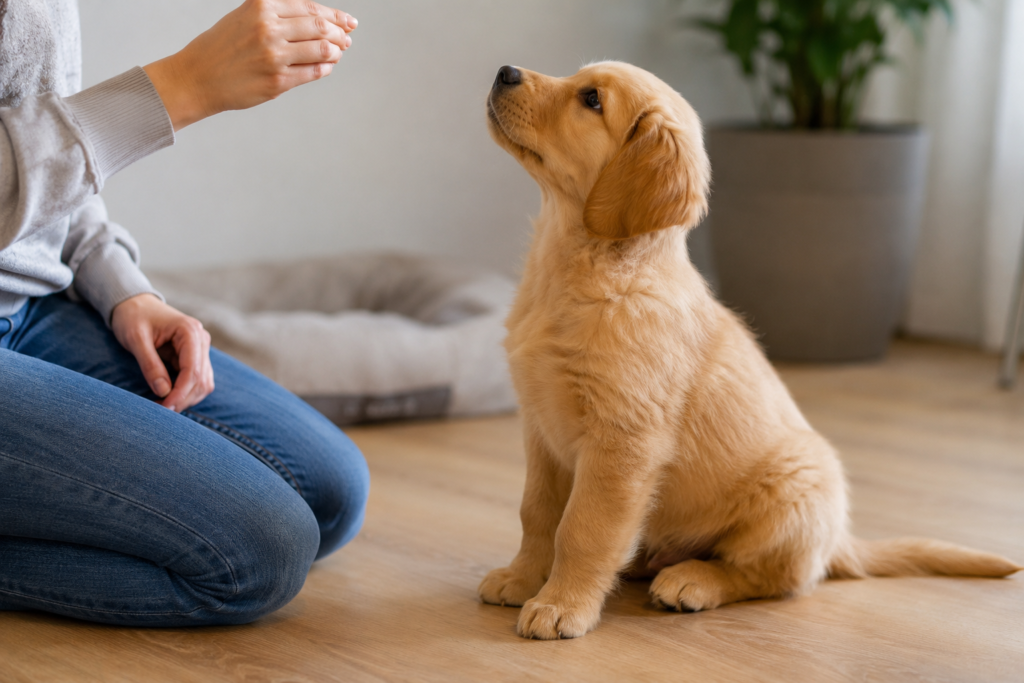
3. Exercise and Mental Stimulation
A tired golden is easier to train, but physical exercise alone is not enough. Mental stimulation matters just as much for this breed.
Daily exercise should include:
- Structured leash walking with lead manners practised throughout, not just for the first five minutes
- Retrieval games that build focus and reinforce recall alongside burning energy
- Puzzle feeders or snuffle mats at mealtimes to drain mental energy
Enforce rest periods too. Overtired goldens become hyperactive and harder to work with. Uninterrupted sleep is when learning consolidates, so do not skip nap time in favour of more exercise.
4. Manage the Mouthy Phase
Golden retrievers are natural retrievers, hardwired to use their mouths. During the puppy stage and into adolescence, this shows up as chewing, carrying household items, and nipping.
Manage this phase with structure, not just redirection:
- Keep designated toys accessible so the dog has a legal outlet for the urge to carry things.
- Never chase a golden retriever that has grabbed something. Ask for a “drop it” or trade the item for a high-value treat.
- Redirect biting immediately and consistently. If the behaviour continues, calmly remove the dog from the interaction and give them a moment to settle before re-engaging.
Consistency is the key. If nipping is sometimes ignored and sometimes corrected, the dog learns nothing useful.
5. Keep Training Sessions Short and Structured
Intelligent dogs like the golden retriever can still have a shorter attention span than owners expect, particularly during adolescence.
Keep structured dog training sessions to 5 to 10 minutes, once or twice a day. End each session while the dog is still engaged and succeeding. Stop before you exceed the dog’s ability to concentrate, not after they have already switched off.
Use the dog’s regular dog food as training treats where possible. This manages portion sizes, supports weight management, and keeps the dog motivated without overfeeding. Training treats work best when they are small and eaten quickly, so the training session keeps its momentum.
Integrate basic training into everyday life. Ask for a sit before meals, a stay before the door opens, and a come when moving between rooms.
A golden retriever learns obedience fastest when it is practised in real situations, not just in formal drills.
6. Socialise with Intention
Early socialisation is non-negotiable for golden retrievers. Without it, the naturally social dog temperament can tip into anxiety, reactivity, or overexcited behaviour around other dogs and people.
Socialisation does not mean letting your golden greet every dog or person it encounters. It means controlled exposure that builds a calm, neutral response to the world.
- Arrange playdates with calm, well-behaved adult dogs rather than chaotic dog park visits.
- Reward your dog for noticing distractions without reacting.
- Expose your golden retriever puppy to different surfaces, sudden sounds, and new environments from an early age.
Owners who want structured group socialisation alongside ongoing training support can find exactly that at the Allbreeds Social Dog Club.
Does Your Golden Retriever Need Training? Contact Allbreeds Today!
If golden retriever training has stalled, or behaviour issues are escalating, professional help makes a significant difference.
Allbreeds K9 Bootcamp offers breed-specific golden retriever training in Perth, with programmes built around the golden retriever’s specific drives and temperament. Training classes, group programmes, and residential bootcamps are all options worth considering depending on where your dog is at.
The seven-day K9 Bootcamp is particularly effective for pet owners who want fast, reliable results built on a balanced training method that goes beyond treats alone.
For more training tips tailored to your golden, speak to our team directly.